

 Home
Home- Bamboo
- Granite
- Lighting
- Interiors
- Traditional Shoji Paper And Acrylics For Repair Or Manufacture
- Komika Range Of Handmade Tables And Benches
- Bespoke Shoji Screen Manufacturing Service
- Japangarden Interior Design Service
- Oriental Style Traditional Futons
- Tatami Flooring
- Interior BoxLights And Bamboo Lights
- Oriental Screens
- Traditional Hot Tubs And Japanese Style Oforu
- Oriental Style Furniture And Furnishings
- Calligraphy Brushes And Inks
- Exteriors
- Specimen Rocks
- Water
- Wind
- The Japangarden Guide
- Japangarden Design
Bestsellers
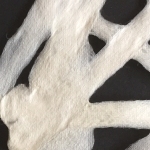
Handmade Japanese papers
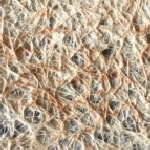
An amazing range of exquisite handmade papers, which could be used for a multitude of applications within interior design specification. There are certain manufacturing restraints - approx 1m x 3m is the sheet size, so to form large items like sliding screens the papers would need to join on timbers or other support.
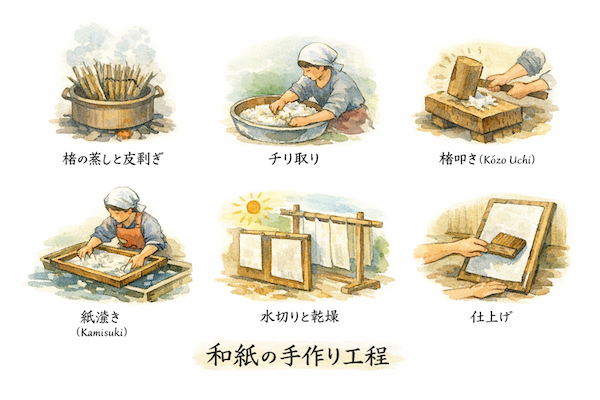
Shoji Paper Making Process Traditional shoji paper (washi) production for your information
1. Steaming & Peeling the Mulberry Bark Japanese: 楮の蒸しと皮剥ぎ (Kōzo no Mushi to Kawahagi) Fresh kōzo (paper mulberry) branches are steamed to soften the bark. The outer layers are peeled away by hand, leaving the inner fibers used for paper.
2. Cleaning the Fibers Japanese: チリ取り (Chiritori) The fibers are washed in water and carefully checked. Small pieces of bark and impurities are removed to keep the paper clean and even.
3. Beating the Fibers Japanese: 楮叩き (Kōzo Uchi) The clean fibers are beaten with wooden mallets. This separates and softens them so they can bond together during papermaking.
4. Forming the Paper Sheets Japanese: 紙漉き (Kamisuki) The fibers are mixed with water and neri, a natural plant liquid that helps spread them evenly. A bamboo screen is dipped into the mixture to form a thin sheet.
5. Draining & Drying Japanese: 水切りと乾燥 (Mizukiri to Kansō) Excess water is removed from the sheet. The paper is brushed onto wooden boards or racks and dried slowly in air or sunlight.
6. Finishing Japanese: 仕上げ (Shiage) Once dry, the paper is carefully removed, trimmed, and checked. The finished shoji paper is light, strong, and softly translucent.
Shoji Paper (障子紙) Made from natural fibers, water, and traditional techniques, shoji paper filters light while maintaining privacy.
The papers below may not follow this process, the above is for information only
It has been used in Japanese interiors for centuries and remains valued for its simplicity and function.
Please contact Spencer Lane on 01531 630091 for more information




INFORMATION
CUSTOMER SERVICE
- Terms & Conditions
- Privacy statement
- Cookie Policy
- Payment Terms
- Delivery
- Mend a Paper or Shoji Screen
- Gravel calculator
- Zen Gardens and Why We Rake
- Japanese Stones and their Use
- Warlon Acrylic and Products
- Japanese Acrylic or Shoji Paper??
- Japangarden JPY to GBP Converter
- A Listening Journey Through Japanese Music
- Japangarden Weekly Focus
- Creating a Japanese Garden in a small space
MY ACCOUNT
CONTACT US
-
ADDRESS:
JapanGarden.co.uk
25 Pound Meadow, Ledbury
HR8 2EU, Herefordshire
United Kingdom (Great Britain) -
TELEPHONE:
+44 (0)1531 630091 -
EMAIL
Contact Us

Copyright © 2004-2026 JapanGarden.co.uk