

 Home
Home- Bamboo
- Granite
- Lighting
- Interiors
- Traditional Shoji Paper And Acrylics For Repair Or Manufacture
- Bespoke Shoji Screen Manufacturing Service
- Japangarden Interior Design Service
- Oriental Style Traditional Futons
- Tatami Flooring
- Interior BoxLights And Bamboo Lights
- Oriental Screens
- Traditional Hot Tubs And Japanese Style Oforu
- Oriental Style Furniture And Furnishings
- Calligraphy Brushes And Inks
- Exteriors
- Specimen Rocks
- Water
- Wind
- End of Line
- Japangarden Design
Mount Fuji and the Snow Monkeys of Nagano
A Journey of Contrast: Mount Fuji and the Snow Monkeys of Nagano
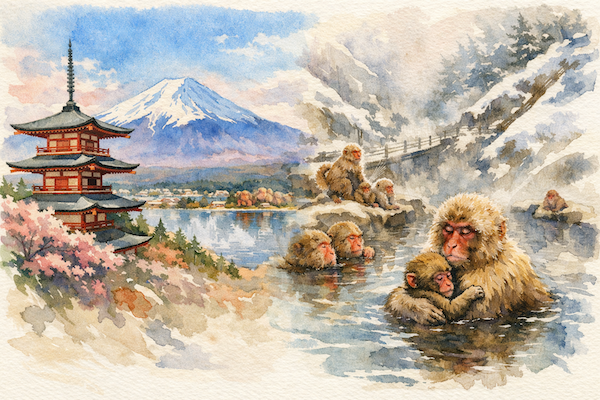
Japan rewards the traveller not through spectacle alone, but through moments of quiet revelation. A still lake mirroring a perfect cone of snow. Steam rising through falling winter light. Silence broken only by wind, water, and the soft shuffle of footsteps along a forest path. Few pairings capture this experience more beautifully than Mount Fuji and the snow monkeys of Nagano.
Mount Fuji — Presence, Not Just a Mountain
Mount Fuji does not simply dominate the skyline — it shapes the emotional landscape of Japan. Its symmetry is so precise it appears almost deliberate, as though placed rather than formed. Yet Fuji is elusive. Clear, crisp views are never guaranteed, lending each sighting a sense of privilege.
For many visitors, the Fuji Five Lakes region offers the most poetic introduction. Here, the mountain reveals itself gradually: reflected in still water, emerging between drifting clouds, or glowing faintly in the early hours before the day fully wakes. Hakone presents a different mood altogether — hot springs, cedar forests, and glimpses of Fuji framed by torii gates and lake mists.
Climbing Fuji, possible only during the short summer season, transforms admiration into intimacy. But even without ascent, simply sharing space with the mountain is deeply affecting. Fuji invites contemplation rather than conquest.
Nagano’s Snow Monkeys — Life in the Elements
High in the mountains of Nagano, another scene unfolds — one that feels almost mythic in winter. Along a forested path, snow softens sound and scale. Then, through drifting steam, figures appear. Japanese macaques, perfectly adapted to the cold, soaking calmly in natural hot springs.
There is no performance here, no staged encounter. The monkeys are indifferent to observers, absorbed in warmth, social rituals, and the simple business of enduring winter. The atmosphere is strikingly peaceful. Snow falls. Water ripples. Breath hangs in the air.
Though winter provides the most iconic imagery, the experience carries its own charm year-round. Spring brings new life and gentler light; autumn adds colour and clarity. Yet it is the stark poetry of winter that lingers most vividly in memory.
The Beauty of Separation
What makes this pairing compelling is not convenience, but contrast. Mount Fuji rests near Tokyo, a symbol of stillness and scale. Nagano lies to the north, its mountain valleys shaped by harsher climates and quieter rhythms. Visiting both is not a single excursion, but a gentle progression through different emotional registers of Japan.
Fuji offers visual perfection — distance, composition, harmony.
Nagano offers intimacy — texture, atmosphere, and unexpected warmth in the coldest settings.
Together, they form a journey less about landmarks and more about sensation.
Travelling with Ease
Japan’s infrastructure allows such transitions to feel effortless. High-speed trains dissolve distance. Luggage forwarding frees movement. Even winter travel, often daunting elsewhere, feels measured and manageable.
A thoughtful itinerary might unfold naturally:
-
A reflective encounter with Fuji’s landscapes
-
A return to Tokyo’s energy and contrast
-
A northward drift into Nagano’s alpine stillness
Not rushed. Not crowded. Simply experienced.
A Study in Stillness
In Japan, the most memorable travel moments often arise from quiet observation. Light shifting across water. Snow settling on stone. Steam rising into cold air. Mount Fuji and the snow monkeys exemplify this philosophy — destinations that do not overwhelm, but gently reveal.
And long after the journey ends, it is this sense of stillness that remains.
INFORMATION
CUSTOMER SERVICE
- Terms & Conditions
- Privacy statement
- Cookie Policy
- Payment Terms
- Delivery
- Mend a Paper or Shoji Screen
- Zen Gardens and Why We Rake
- Japanese Stones and their Use
- Visiting Japan for the First Time
- 20 Tips for Visiting a Sumo Wrestling Event for the First Time
- Visiting a Noh Performance: 20 Tips for First-Time Audiences
- 20 Japanese Meals: From Workers’ Food to High-End Cuisine
- Arrival in Japan: From Narita Airport to Tokyo
- A First Visit to a Japanese Ryokan
- Mount Fuji and the Snow Monkeys of Nagano
- Understanding the Tea Ceremony
- Warlon Acrylic and Products
MY ACCOUNT
CONTACT US
-
ADDRESS:
JapanGarden.co.uk
25 Pound Meadow, Ledbury
HR8 2EU, Herefordshire
United Kingdom (Great Britain) -
TELEPHONE:
+44 (0)1531 630091 -
EMAIL
Contact Us

Copyright © 2004-2026 JapanGarden.co.uk