

 Home
Home- Bamboo
- Granite
- Lighting
- Interiors
- Traditional Shoji Paper And Acrylics For Repair Or Manufacture
- Bespoke Shoji Screen Manufacturing Service
- Japangarden Interior Design Service
- Oriental Style Traditional Futons
- Tatami Flooring
- Interior BoxLights And Bamboo Lights
- Oriental Screens
- Traditional Hot Tubs And Japanese Style Oforu
- Oriental Style Furniture And Furnishings
- Calligraphy Brushes And Inks
- Exteriors
- Specimen Rocks
- Water
- Wind
- End of Line
- The Japangarden Guide
- Japangarden Design

A toe dip into Shakkei, Borrowed Scenery
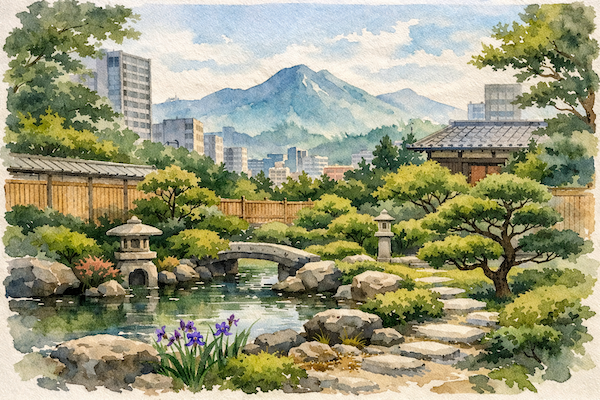
This image illustrates Shakkei (Borrowed Scenery) by visually blending the garden with the distant landscape so the eye reads them as a single composition rather than separate layers.
1. Dominant Borrowed Element (Far Field)
The mountain range forms the borrowed scenery. ( useful to have a handy mountain nearby but any landmark will do)
Although physically outside the garden, it appears intentionally “placed” within the design because:
-
It occupies the central visual axis
-
Its scale dwarfs the garden, implying vast distance
The mountains feel like the garden’s backdrop rather than external geography.
2. Visual Transition (Middle Field)
The trees and rooflines act as a bridge between worlds:
-
Urban buildings are partially concealed
-
Garden vegetation overlaps the cityscape
-
Edges are softened, avoiding harsh separation
This prevents the background from feeling detached or intrusive.
3. Anchoring Foreground (Near Field)
Traditional garden elements — pond, stones, bridge, lantern — establish the designed space:
-
Stronger contrast and detail pull the viewer forward
-
Horizontal lines lead the eye outward
-
Shapes subtly echo those in the mountains
The foreground invites the gaze toward the distant scenery.
4. Concealment of Boundaries
Shakkei depends on hiding where the garden ends:
-
Fences and walls are visually subdued
-
Buildings are muted and partially masked
There is no obvious visual barrier stopping the eye, you look straight through and up.
5. Atmospheric Perspective
Depth is reinforced through design techniques:
-
A blurring of the distant elements
-
Reduced detail on mountains and city
-
Greater texture and detail in the foreground
This mimics natural human perception of distance.
Why the Shakkei Effect Works Here
The viewer subconsciously interprets:
Garden → Trees → City → Mountains
as one continuous landscape, not separate zones.
The external mountains become an intentional design component rather than a background accident.
9. View the Garden From One Main Angle
Standing stone gardens are usually composed for one primary viewpoint.
Tip:
-
Place stones, then step back to where you’ll usually stand or sit
-
Adjust angles until the composition feels calm from that position
10. Stop Before It Feels Finished
This sounds strange—but it’s essential.
Japanese stone gardens often feel:
-
Slightly incomplete
-
Asymmetrical
-
Quiet rather than decorative
That restraint is what creates serenity.
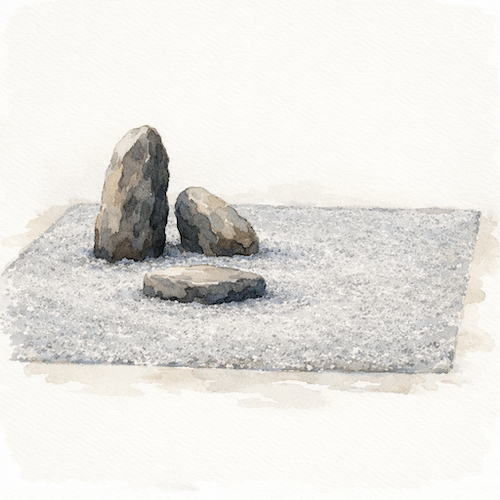
A Simple, Fail-Safe Starter Layout
If you want something foolproof:
-
Area: 2 × 2 m
-
Stones: 3
-
Ground: silver grey gravel
-
One stone tall, one medium, one low
-
Slightly angled, grouped asymmetrically
INFORMATION
CUSTOMER SERVICE
- Terms & Conditions
- Privacy statement
- Cookie Policy
- Payment Terms
- Delivery
- Mend a Paper or Shoji Screen
- Gravel calculator
- Zen Gardens and Why We Rake
- Japanese Stones and their Use
- Natural Stone, Moss & Lichen in the Japanese Garden
- Understanding the Tea Ceremony
- Warlon Acrylic and Products
- Japanese Acrylic or Shoji Paper??
MY ACCOUNT
CONTACT US
-
ADDRESS:
JapanGarden.co.uk
25 Pound Meadow, Ledbury
HR8 2EU, Herefordshire
United Kingdom (Great Britain) -
TELEPHONE:
+44 (0)1531 630091 -
EMAIL
Contact Us

Copyright © 2004-2026 JapanGarden.co.uk