

 Home
Home- Bamboo
- Granite
- Lighting
- Interiors
- Traditional Shoji Paper And Acrylics For Repair Or Manufacture
- Bespoke Shoji Screen Manufacturing Service
- Japangarden Interior Design Service
- Oriental Style Traditional Futons
- Tatami Flooring
- Interior BoxLights And Bamboo Lights
- Oriental Screens
- Traditional Hot Tubs And Japanese Style Oforu
- Oriental Style Furniture And Furnishings
- Calligraphy Brushes And Inks
- Exteriors
- Specimen Rocks
- Water
- Wind
- End of Line
- Japangarden Design
Understanding the Tea Ceremony
The Japanese Tea Ceremony
An appreciation of presence, season, and quiet hospitality
For many first-time visitors to Japan, the tea ceremony is not what they expect.
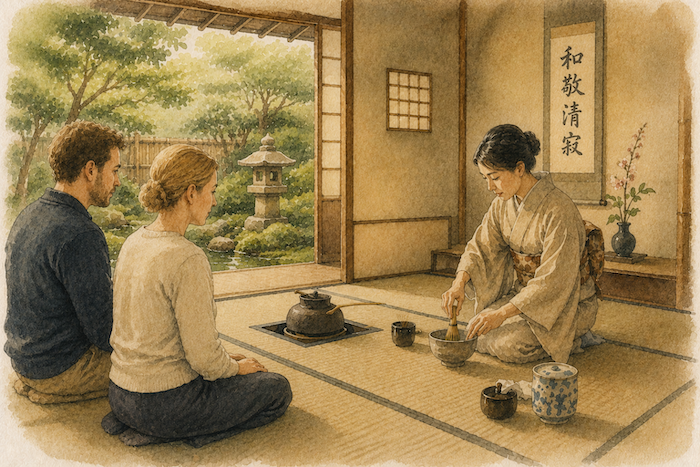
There is no performance, no flourish, and no attempt to impress. Instead, there is a profound attentiveness to seemingly ordinary actions. A kettle is placed. A bowl is turned. Tea is whisked. Each movement is deliberate, refined through centuries of repetition.
To Western eyes, it can appear remarkably simple.
Yet, like a Japanese garden, its depth reveals itself slowly.
Entering Another Pace
The tea ceremony begins long before tea is served.
Guests pass through a garden approach, often designed to create a gentle separation from the outside world. Stone, moss, water and carefully controlled views encourage a gradual slowing of mind and body. The path itself becomes part of the experience.
This transition reflects a fundamental principle of Japanese design: before we can appreciate beauty, we must first become present enough to notice it.
The Beauty of Restraint
The tea room is modest in scale and intentionally free from distraction. Natural materials dominate — timber, paper, bamboo, clay and woven tatami.
Nothing is excessive. Nothing competes for attention.
A single flower arrangement may celebrate the season. A hanging scroll may offer a moment of reflection. Every object has purpose, every detail has meaning.
Like the finest Japanese gardens, the space is defined as much by what has been omitted as by what remains.
A Conversation Without Words
As the host prepares the tea, guests observe quietly.
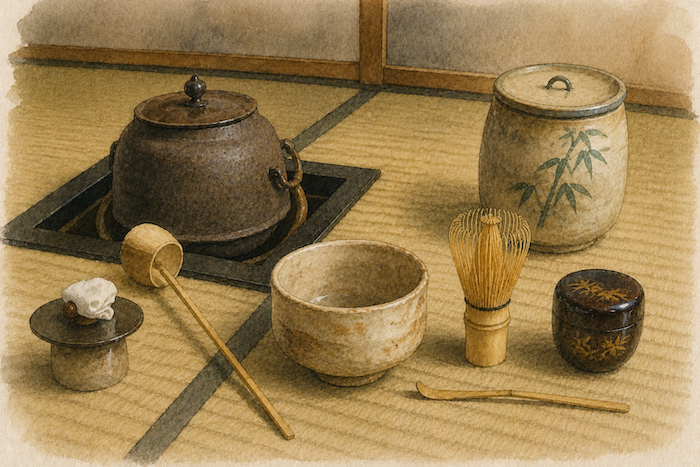
The sound of water heating. The soft movement of silk. The rhythm of bamboo against ceramic. Light filtering through paper screens.
The ceremony encourages a level of awareness that modern life rarely allows. Small details become significant. Ordinary actions become worthy of attention.
What appears repetitive is, in fact, deeply human — an expression of care communicated through action rather than words.
The Season in a Bowl
Seasonality lies at the heart of the tea ceremony.
The utensils, flowers, sweets and even the manner in which tea is prepared may change throughout the year. Spring, summer, autumn and winter each bring their own character and atmosphere.
This sensitivity to the seasons mirrors the philosophy of Japanese gardens, where beauty is found not in permanence but in continual change.
Nothing is static. Nothing remains exactly as it was.
The Meaning of Hospitality
Perhaps the most important concept within the tea ceremony is ichigo ichie — often translated as "one time, one meeting."
The idea reminds us that every gathering is unique and can never be repeated in precisely the same way. The people, the weather, the season and the moment itself exist together only once.
The host therefore prepares with complete sincerity, while guests participate with gratitude and attention.
It is a philosophy that extends far beyond tea.
More Than a Ritual
To describe the tea ceremony as simply making tea would be to misunderstand its purpose.
It is an exercise in mindfulness, an appreciation of craftsmanship, a celebration of seasonality and a lesson in living with intention.
Like a Japanese garden, it teaches that tranquillity is not something added to life. It emerges naturally when unnecessary distractions are removed.
For many visitors from the UK, the greatest surprise is not the tea itself, but the realisation that an hour spent in quiet observation can feel richer and more memorable than an entire day of activity.
The tea ceremony leaves no souvenir to take home.
Instead, it offers something more valuable: a reminder that beauty often resides in the smallest of moments, waiting patiently to be noticed.
INFORMATION
CUSTOMER SERVICE
- Terms & Conditions
- Privacy statement
- Cookie Policy
- Payment Terms
- Delivery
- Mend a Paper or Shoji Screen
- Zen Gardens and Why We Rake
- Japanese Stones and their Use
- Visiting Japan for the First Time
- 20 Tips for Visiting a Sumo Wrestling Event for the First Time
- Visiting a Noh Performance: 20 Tips for First-Time Audiences
- 20 Japanese Meals: From Workers’ Food to High-End Cuisine
- Arrival in Japan: From Narita Airport to Tokyo
- A First Visit to a Japanese Ryokan
- Mount Fuji and the Snow Monkeys of Nagano
- Understanding the Tea Ceremony
- Warlon Acrylic and Products
MY ACCOUNT
CONTACT US
-
ADDRESS:
JapanGarden.co.uk
25 Pound Meadow, Ledbury
HR8 2EU, Herefordshire
United Kingdom (Great Britain) -
TELEPHONE:
+44 (0)1531 630091 -
EMAIL
Contact Us

Copyright © 2004-2026 JapanGarden.co.uk