

 Home
Home- Bamboo
- Granite
- Lighting
- Interiors
- Traditional Shoji Paper And Acrylics For Repair Or Manufacture
- Bespoke Shoji Screen Manufacturing Service
- Japangarden Interior Design Service
- Oriental Style Traditional Futons
- Tatami Flooring
- Interior BoxLights And Bamboo Lights
- Oriental Screens
- Traditional Hot Tubs And Japanese Style Oforu
- Oriental Style Furniture And Furnishings
- Calligraphy Brushes And Inks
- Exteriors
- Specimen Rocks
- Water
- Wind
- End of Line
- The Japangarden Guide
- Japangarden Design
Ikigai — The Japanese Art of Finding Meaning in Everyday Life
Ikigai — The Japanese Art of Finding Meaning in Everyday Life
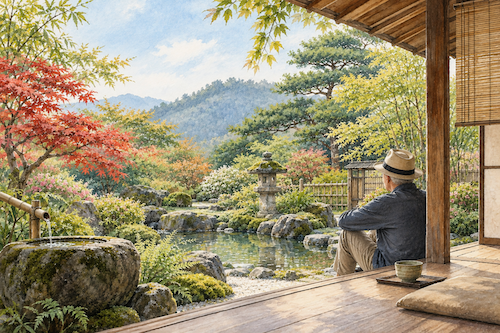
生き甲斐 — Ikigai
What makes life worth living?
Few Japanese words have travelled as successfully into the English language as ikigai.
It is often translated as “a reason for living”, “a purpose in life” or “a reason to get up in the morning”. But the Japanese idea is more subtle and considerably broader than these simple translations suggest.
At its heart, ikigai is about what gives life value, meaning, motivation or a sense that living is worthwhile. The Japanese Digital Daijisen defines it as something worth living for, or something that provides encouragement and joy in living.
It does not necessarily mean finding a great ambition, a perfect career or one single purpose. Ikigai can be found in relationships, family, work, hobbies, caring for others, learning, creativity, nature — or in the quiet pleasures of ordinary daily life.
What does Ikigai mean?
The most common modern spellings are 生き甲斐 and 生きがい.
The word combines:
生き (iki) — relating to living or being alive
甲斐 (gai) — worth, value or the worthwhile result of something. The Japanese dictionary Nihon Kokugo Daijiten gives ikigai meanings including the significance of being alive and the motivation or sense of fulfilment associated with living.
Put simply:
Ikigai is that which makes life feel worthwhile.
The idea can range from the very ordinary — having something enjoyable to do or someone to care about — to deeper questions about the meaning and value of one's life.
The Japanese Sekai Daihyakka Jiten describes ikigai broadly as things that give meaning and value to life and sustain a person's life, ranging from everyday motivation to more fundamental questions about how one should live.
Ikigai is not necessarily your job
One of the most common misunderstandings of ikigai comes from its modern presentation in the West.
It is now very common to see ikigai represented by four overlapping circles:
-
What you love
-
What you are good at
-
What the world needs
-
What you can be paid for
The centre of these four circles is then labelled “ikigai”.
This can be a useful modern exercise for thinking about work and personal direction, but it should not be confused with the traditional Japanese definition of the word.
The familiar four-circle model is a modern interpretation of ikigai, particularly associated with the popular work of Héctor García and Francesc Miralles. It can be useful when considering career, vocation and purpose, but the Japanese concept itself is broader than this four-part framework.
Academic research has also pointed out that the four-circle interpretation does not necessarily represent the original Japanese connotation of ikigai.
Japanese usage can encompass purpose, meaning, fulfilment, relationships, activities and the felt value of living.
A useful academic discussion of the concept can be found in this research on ikigai and meaning in life.
Something does not have to be profitable, socially important or exceptional to be someone's ikigai.
A hobby, relationship, responsibility or quiet daily ritual can be just as meaningful.
Everyday Ikigai
Perhaps the most attractive aspect of ikigai is that it does not require a person to accomplish something extraordinary.
Your ikigai might be:
-
caring for your family
-
maintaining a garden
-
meeting friends regularly
-
teaching someone a skill
-
volunteering in the community
-
making something with your hands
-
learning about something that fascinates you
-
walking through the countryside
-
looking after a pet
-
cooking for people you care about
-
watching the seasons change
-
having something to look forward to tomorrow
Research involving older people in Japan has found that sources and experiences associated with ikigai can include hobbies, leisure, friendships, social participation, contribution, accomplishment and personal development.
In other words, ikigai does not necessarily ask:
“What great thing am I going to achieve?”
It can be a much quieter question:
“What makes my life feel worthwhile?”
Ikigai and the changing seasons of life
Our sources of meaning do not have to remain the same throughout life.
When we are young, ikigai might be found in discovery, friendship, education and the excitement of possibilities.
Later it may be connected with work, family, creating a home and caring for others.
As life changes, so can our reasons for getting up in the morning.
Retirement, for example, does not necessarily mean the loss of purpose. It can create the opportunity to rediscover activities that previously had little time available for them — gardening, walking, travelling, learning, volunteering, making things or simply spending more time with other people.
There may not be one great answer.
There may be many small ones.
Ikigai and the Japanese Garden
There is a particularly natural connection between the idea of ikigai and the experience of a Japanese garden.
This does not mean that Japanese gardens were designed specifically to represent ikigai. Rather, the garden provides an environment in which many of the qualities associated with a meaningful life can be experienced.
The Japanese Garden Society's guide to Japanese gardens describes the Japanese garden as an attempt to express the spirit of nature, recognising seasonal change and the transience of life. It also emphasises the importance of the viewer's experience, attention to detail, changing views and the relationship between natural materials and the garden as a whole.
A garden is never completely finished.
Plants grow.
Moss spreads.
Stone weathers.
Water changes with the weather.
Light moves across a path.
Maple leaves appear in autumn and disappear again.
The gardener returns to prune, sweep, plant, repair and care.
There is something deeply compatible between this continual process of caring for a garden and the idea of ikigai.
A garden can give life a rhythm
Consider the simple activities involved in caring for a Japanese garden:
-
sweeping a path
-
removing fallen leaves
-
pruning a maple
-
clearing moss from a stone
-
maintaining a bamboo fence
-
raking gravel
-
watching the first spring growth
-
observing autumn colour
-
listening to running water
None of these activities is necessarily important in isolation.
Yet together they create a rhythm of attention, care and anticipation.
Perhaps this is one of the quietest expressions of ikigai:
Having something worth caring for, and having the time to notice it changing.
This is an interpretation rather than a traditional Japanese definition of ikigai. But it provides a useful way of exploring how Japanese gardens can become places of attention, continuity and everyday enjoyment.
Ikigai, Wabi-sabi and Ma
Ikigai should not be confused with other Japanese concepts such as wabi-sabi or ma. They are different ideas.
However, they can sit comfortably alongside one another when considering Japanese attitudes towards everyday life.
Ikigai — 生き甲斐
What gives life value, meaning, motivation or a sense that living is worthwhile.
Wabi-sabi — 侘び寂び
An aesthetic sensibility associated with simplicity, imperfection, impermanence and the beauty of things that change.
Ma — 間
The space, interval or pause between things.
In Japanese design, what is left empty can be as important as what is placed there.
In a Japanese garden these ideas can sometimes be experienced together: a weathered stone, an open area of gravel, the pause between two stepping stones, or a tree changing through the seasons.
They should nevertheless be understood as separate Japanese concepts, rather than different names for the same philosophy.
Ikigai and later life
Ikigai has attracted considerable interest from researchers studying ageing and wellbeing in Japan.
A large longitudinal study of Japanese adults aged 65 and over examined whether having ikigai was associated with subsequent physical, psychological and social outcomes.
The study used two nationwide datasets, involving 6,441 and 8,041 older Japanese adults, and followed outcomes over a three-year period. Having ikigai was associated with lower risks of functional disability and dementia, as well as better outcomes in areas including happiness, life satisfaction and some social measures.
Importantly, these are associations rather than proof that ikigai itself causes better health or longer life.
Read the full study on PubMed.
The significance of this research is perhaps less about proving that ikigai makes people healthier and more about examining the relationship between meaning, purpose, engagement, relationships and wellbeing.
Finding your own Ikigai
There is no official test that can tell you what your ikigai is.
Instead, it may be more useful to look at your own life and notice what is already there.
What makes you lose track of time?
Think about activities that naturally absorb your attention.
They do not have to be productive or profitable.
What do you look forward to?
It might be a person, a place, a weekly activity, a journey, a season or something as simple as sitting in the garden with a cup of tea.
What has mattered to you over the years?
Look for recurring themes.
Perhaps you have always enjoyed making things, helping people, being outdoors, teaching, learning or caring for something.
Where do you feel useful?
Meaning often grows when something we do benefits another person, a community, an animal, a garden or a place.
What would you like to continue doing?
Ikigai can be found in continuity — continuing to learn, practise, create, care and contribute.
A simple garden exercise
Try sitting quietly in your garden for ten minutes.
Do not try to improve it.
Do not make a list of jobs that need doing.
Simply observe.
Notice the movement of leaves, the sound of birds, the changing light, the texture of stone, the movement of water or the scent of plants.
Then ask yourself:
“Why did I enjoy noticing these things?”
The answer may reveal something about your own sources of meaning.
The deeper idea of Ikigai
Perhaps the most valuable lesson of ikigai is that meaning does not always arrive as a great revelation.
It can accumulate slowly.
A conversation.
A morning walk.
A garden cared for over many years.
A skill passed to another person.
A tree watched through the seasons.
A meal prepared for people you care about.
A project that keeps drawing you back.
Each may seem small when considered alone.
Together, they can form a life that feels worthwhile.
Ikigai is perhaps less about discovering one great purpose in life, and more about recognising the things that make life worth living.
Explore more Japanese ideas
Japanese Gardens
Discover the principles, features and traditions behind Japanese garden design.
Japanese Culture & Philosophy
Explore the ideas, aesthetics and traditions that have influenced Japanese gardens and everyday life.
Japanese Garden Design
Understand how Japanese gardens use space, plants, stone, water, views and seasonal change.
Wabi-sabi
Explore the Japanese appreciation of imperfection, impermanence and simplicity.
Ma — The Beauty of Space
Discover the importance of space, pause and emptiness in Japanese design.
Explore. Understand. Create.
Japangarden explores Japanese gardens, Japanese culture and the ideas behind them — helping us to understand not only how Japanese gardens are created, but why they can have such a powerful effect upon us.
INFORMATION
CUSTOMER SERVICE
- Terms & Conditions
- Privacy statement
- Cookie Policy
- Payment Terms
- Delivery
- Mend a Paper or Shoji Screen
- Gravel calculator
- Zen Gardens and Why We Rake
- Japanese Stones and their Use
- Natural Stone, Moss & Lichen in the Japanese Garden
- Understanding the Tea Ceremony
- Warlon Acrylic and Products
- Japanese Acrylic or Shoji Paper??
- Ikigai — The Japanese Art of Finding Meaning in Everyday Life
MY ACCOUNT
CONTACT US
-
ADDRESS:
JapanGarden.co.uk
25 Pound Meadow, Ledbury
HR8 2EU, Herefordshire
United Kingdom (Great Britain) -
TELEPHONE:
+44 (0)1531 630091 -
EMAIL
Contact Us

Copyright © 2004-2026 JapanGarden.co.uk