

 Home
Home- Bamboo
- Granite
- Lighting
- Interiors
- Traditional Shoji Paper And Acrylics For Repair Or Manufacture
- Bespoke Shoji Screen Manufacturing Service
- Japangarden Interior Design Service
- Oriental Style Traditional Futons
- Tatami Flooring
- Interior BoxLights And Bamboo Lights
- Oriental Screens
- Traditional Hot Tubs And Japanese Style Oforu
- Oriental Style Furniture And Furnishings
- Calligraphy Brushes And Inks
- Exteriors
- Specimen Rocks
- Water
- Wind
- End of Line
- The Japangarden Guide
- Japangarden Design
Natural Stone, Moss & Lichen in the Japanese Garden
Natural Stone, Moss & Lichen
How weathered stone, woodland planting and the slow work of nature can inspire a more convincing and timeless Japanese garden.
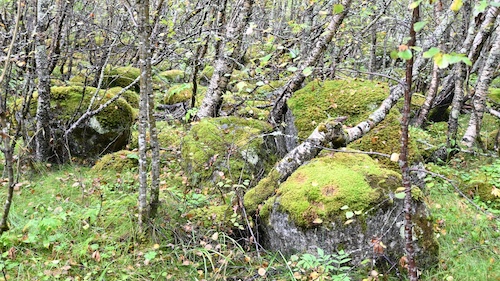
Natural boulders partly enveloped by moss, grasses, fallen leaves and woodland growth — a useful reference for naturalistic Japanese garden design.
The beauty of stones that appear to have always been there
A Japanese garden is not simply a collection of beautiful objects. Its aim is to create an impression of nature in balance — a landscape that feels settled, quiet and unforced.
Stone is one of the foundations of this idea. A natural boulder can suggest a mountain, a rocky outcrop or a fragment of a much larger landscape. Yet the character of the stone is only part of the composition. How it is placed, what surrounds it and what is allowed to happen over time are equally important.
In the landscape shown here, the stones do not read as isolated features. They belong to the woodland, partly embedded in the ground and softened by moss, lichens, grasses and fallen leaves.
A stone should look as though it belongs
In Japanese garden design, the arrangement of natural stones is known as ishigumi (石組). Shape, direction, surface markings, colour, apparent weight and the relationship between neighbouring stones all influence placement.
The objective is not to make a boulder look as though it has simply been delivered and put down. It should feel settled into the landscape — as though it has always occupied that position.
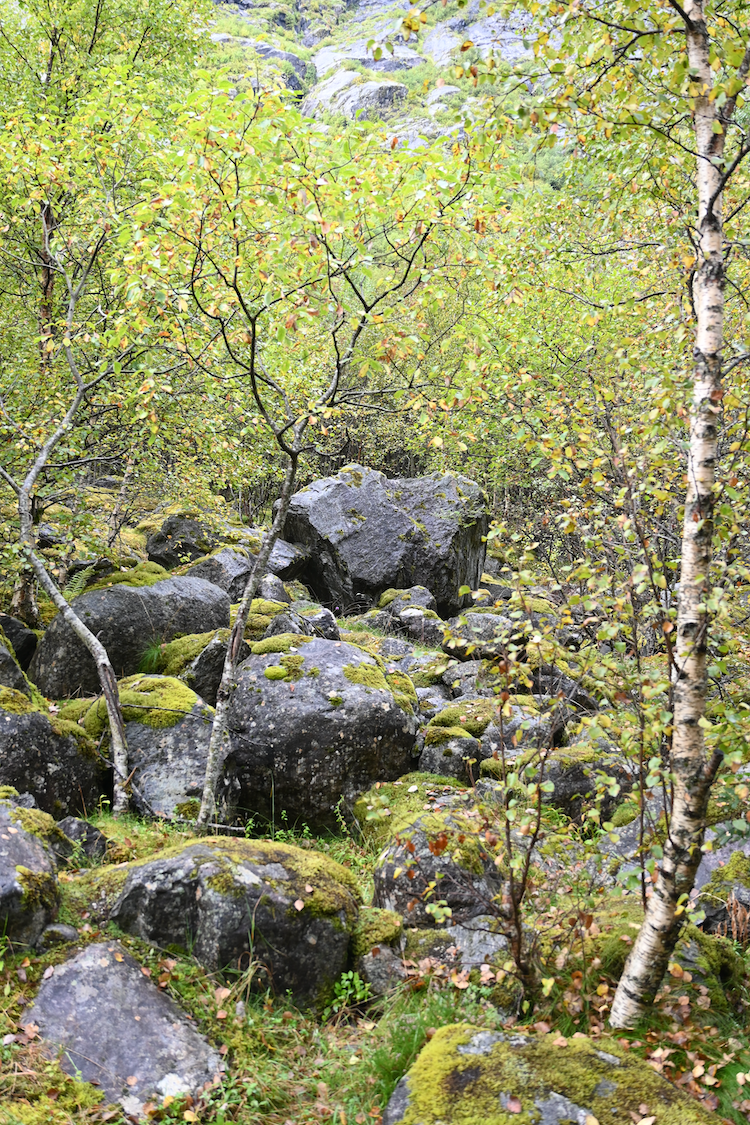
Moss follows the contours of the stones, softening their edges while leaving their underlying forms visible.
Consider the stone from every direction
Before positioning a substantial natural stone, study its strongest face, its natural planes and markings, and whether it feels upright, reclining or horizontal. The most convincing orientation is often the one that follows the stone's own character.
- Study the natural character of the stone before deciding its orientation.
- Allow part of the stone to disappear into the ground where appropriate.
- Relate the stone to neighbouring stones, planting and changes in ground level.
- Consider the principal viewpoint without making the composition look theatrical.
- Imagine how the planting will develop around the stone over the years.
Stone groups rather than isolated objects
Nature rarely presents every rock as an isolated feature. Stones occur in relationships: a substantial boulder may be accompanied by smaller stones, partly buried fragments may disappear into vegetation, while another rock appears some distance away.
This creates rhythm and visual continuity. A carefully considered group can suggest a much larger geological landscape than the physical dimensions of a garden might otherwise allow.
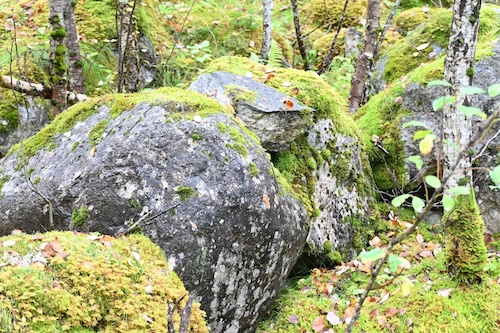
Weathering creates subtle variations of grey, green and pale lichen across the surface of natural stone.
The quiet transformation caused by time
A newly installed stone may initially look separate from its surroundings. Gradually, however, the garden begins to take possession of it.
Leaf litter accumulates. Tiny plants establish themselves in cracks. Moss spreads across shaded surfaces. Lichens colonise exposed areas. Grasses and groundcover soften the edges, while roots pass around and beneath the stone.
The stone gradually becomes part of the landscape.
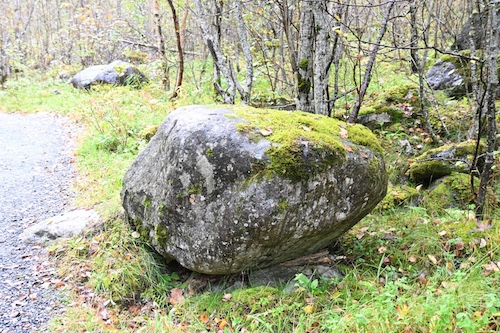
A large boulder can feel rooted in its setting when its base is integrated with the surrounding ground.
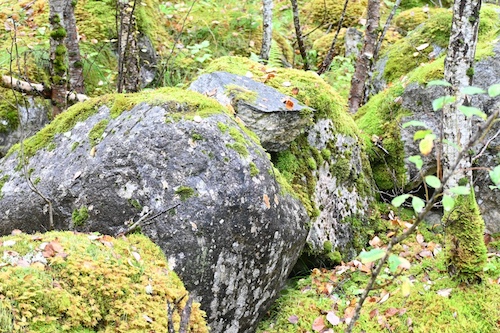
A natural grouping uses differences in size, height and orientation to create an organic composition.
Planting for a living stone landscape
The planting around natural stone is best considered as a series of transitions rather than a hard boundary. Moss, low groundcover and grasses can soften the immediate edge of the rock, while shrubs and trees frame the composition beyond.
Suitable planting will depend on the site's soil, light and moisture, but the principle remains the same: allow the vegetation to work with the stone rather than simply decorate it.
A sequence such as stone → moss → groundcover → grasses → shrubs → trees can create increasingly softer layers.
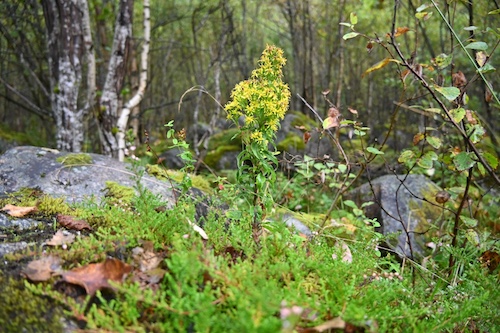
Small flowering plants bring seasonal change without overwhelming the stone composition.
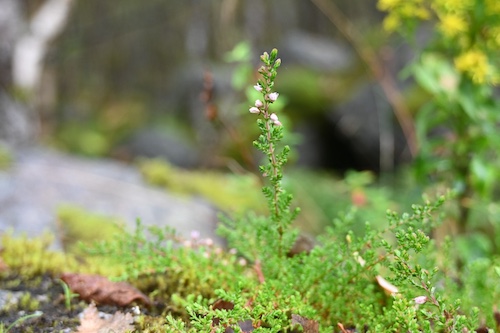
Close observation reveals the fine detail that makes a natural stone landscape feel alive.
Lichen: another layer of age
Lichen can produce delicate grey, green, yellow and orange patterns across weathered stone. It is a living partnership between a fungus and a photosynthetic organism, and develops slowly on suitable surfaces.
Rather than treating lichen as decoration, allow naturally occurring growth to contribute its own marks and colours. These details are part of the visual language of age.
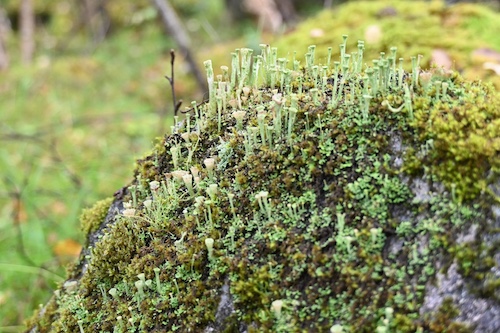
Cup-shaped lichen growing amongst moss — a miniature landscape on the surface of a boulder.
Stone as habitat
A natural stone composition can become much more than a visual feature. Crevices, shaded spaces beneath stones, moss and leaf litter create a succession of small habitats for insects and other invertebrates.
- Shelter: crevices and spaces beneath stones provide refuge for small invertebrates.
- Basking sites: sun-warmed stone can provide useful microhabitats for insects and other wildlife.
- Moisture: shaded areas around stones can retain damp conditions for moss and moisture-loving organisms.
- Leaf litter: accumulated organic matter adds another layer of habitat around the stone.
Designing with time in mind
When placing natural stone, imagine the garden not only as it looks today, but as it might look in five, ten or twenty years.
Where will moss establish? Which plants will eventually frame the stone? Where will rainwater collect? Where will leaves naturally accumulate? Which areas will remain shaded?
The aim is not to make a garden that looks artificially old. It is to create a garden with the capacity to become old naturally.
JapanGarden design principle
Choose the stone carefully. Place it naturally. Plant around it thoughtfully. Then allow time to complete the composition.
This approach is particularly valuable when using large natural boulders: their geological character provides the permanence, while planting, weathering and the passage of seasons provide the sense of age.
© JapanGarden · Japanese garden materials, ideas and inspiration. © Images by Spencer Lane 2026 Jostedalsbreen National Park, Loen, Vestland, Norway
INFORMATION
CUSTOMER SERVICE
- Terms & Conditions
- Privacy statement
- Cookie Policy
- Payment Terms
- Delivery
- Mend a Paper or Shoji Screen
- Gravel calculator
- Zen Gardens and Why We Rake
- Japanese Stones and their Use
- Natural Stone, Moss & Lichen in the Japanese Garden
- Understanding the Tea Ceremony
- Warlon Acrylic and Products
- Japanese Acrylic or Shoji Paper??
MY ACCOUNT
CONTACT US
-
ADDRESS:
JapanGarden.co.uk
25 Pound Meadow, Ledbury
HR8 2EU, Herefordshire
United Kingdom (Great Britain) -
TELEPHONE:
+44 (0)1531 630091 -
EMAIL
Contact Us

Copyright © 2004-2026 JapanGarden.co.uk