

 Home
Home- Bamboo
- Granite
- Lighting
- Interiors
- Traditional Shoji Paper And Acrylics For Repair Or Manufacture
- Komika Range Of Handmade Tables And Benches
- Bespoke Shoji Screen Manufacturing Service
- Japangarden Interior Design Service
- Oriental Style Traditional Futons
- Tatami Flooring
- Interior BoxLights And Bamboo Lights
- Oriental Screens
- Traditional Hot Tubs And Japanese Style Oforu
- Oriental Style Furniture And Furnishings
- Calligraphy Brushes And Inks
- Exteriors
- Specimen Rocks
- Water
- Wind
- The Japangarden Guide
- Japangarden Design
How to Stay Cool the Japanese Way
How to Stay Cool the Japanese Way
Shade, water, breeze and a little Japanese ingenuity
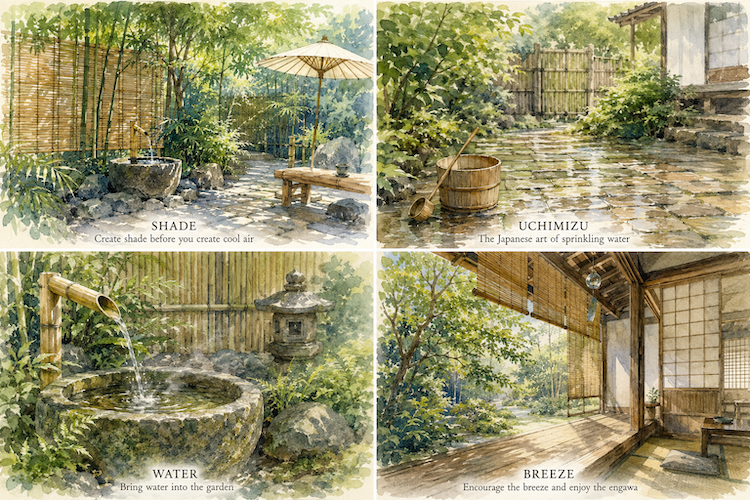
When summer arrives in Japan, keeping cool is not simply a matter of turning up the air conditioning.
Traditional Japanese homes and gardens have long used shade, moving air, water, natural materials and the careful use of space to create a feeling of coolness.
It is an approach that works surprisingly well in a British garden too.
At Japangarden, we believe that a Japanese garden should do more than look beautiful. It should create an atmosphere – a place that feels calm, natural and inviting throughout the seasons.
Summer is perhaps when this matters most.
1. Create shade before you create cool air
One of the simplest Japanese ideas is also one of the most effective: keep the sun out in the first place.
Traditional sudare – woven bamboo or reed screens – were used to filter strong sunlight while allowing air to pass through. Rather than completely closing off a room, they create a soft veil between inside and outside.
The same principle can be applied to a modern garden.
A bamboo screen, pergola, parasol or carefully positioned planting can provide shade without making the garden feel enclosed.
The effect is particularly beautiful when sunlight filters through bamboo or foliage, creating changing patterns of light and shadow across the ground.
Japangarden has a wide range of bamboo fences, screening and poles that can be used to create privacy, filtered shade and structure within the garden.
Think of shade not as something that blocks the garden, but as another layer within it.
2. The Japanese art of Uchimizu
There is a wonderful Japanese summer tradition called uchimizu – the sprinkling of water over garden paths, courtyards and other outdoor surfaces.
As water evaporates from a warm surface, it can provide some local cooling. But uchimizu is about more than temperature.
The sound of water being sprinkled, the darkening of stone and gravel, and the temporary glistening of the garden all contribute to a feeling of freshness.
Try lightly watering a stone path, courtyard or gravel garden in the early morning or evening.
It is a small ritual, but one that changes the character of the garden.
3. Bring water into the garden
Water has always had an important place in Japanese garden design.
It may be a pond, stream, basin, fountain or simply the gentle movement of water through a kakei bamboo water spout.
The physical cooling effect of a small garden water feature should not be exaggerated – but water has a powerful visual and psychological cooling effect.
A still surface reflects the sky.
Moving water catches the light.
The sound of a bamboo fountain interrupts the heat and stillness of a summer afternoon.
At Japangarden, our Japanese water collection includes granite water basins, granite water features, bamboo fountains and traditional Japanese-style rain chains.
For a more traditional arrangement, take a look at our granite water basins, which can be combined with a bamboo kakei water spout.
Our large bamboo fountain, for example, can be used on its own or with a granite water basin.
4. Encourage the breeze
Traditional Japanese architecture was designed to make the most of natural ventilation.
The engawa – the veranda-like space between the interior and the garden – provides a shaded transition between inside and outside. Doors and screens could be opened to allow air to move through the house.
The modern equivalent might be a shaded veranda, covered terrace or garden room.
The principle is simple:
Don't just try to cool the air – help the air move.
In a garden, this means avoiding unnecessarily solid barriers where a more open screen, planting or pergola could provide privacy while still allowing the breeze to pass.
A bamboo screen can be particularly effective because it provides a degree of privacy and shade without necessarily creating the visual weight of a solid wall.
5. Let plants provide the shade
Japanese gardens often use trees and carefully placed planting to create a layered sense of enclosure.
A tree canopy can provide overhead shade.
Bamboo can provide filtered shade and movement.
Shrubs and grasses soften the edges.
Ground planting and moss-like textures help create the impression of a cooler, more enclosed landscape.
This is particularly relevant in Britain. A Japanese-style garden does not need to depend upon exotic plants. The important things are form, texture, seasonal interest and the way plants interact with space.
Our Japangarden Design section contains practical ideas for creating Japanese-inspired gardens using natural form, subtle detail and creative use of space.
6. The Engawa – a place between garden and house
Perhaps one of the most appealing Japanese ideas for summer is the engawa.
It is neither quite indoors nor outdoors.
It provides a shaded place to sit, look into the garden and enjoy the movement of air without being exposed to the full heat of the sun.
A modern garden can achieve something similar with a veranda, covered seating area, pergola or Japanese-style garden building.
Japangarden also creates bespoke garden buildings and screens, offering ways to establish a calm transitional space between house and garden. See our Japangarden Design and practical tips for inspiration.
For interiors, our Shoji roller blinds offer another way of filtering strong sunlight while retaining the characteristic softness of Japanese paper.
7. A parasol – the simplest form of Japanese shade
Sometimes the simplest solution is the best.
A traditional Japanese-style bamboo umbrella can transform a sunny seating area into somewhere much more inviting.
Japangarden offers a selection of handmade bamboo umbrellas, including sizes from approximately 1.25m through to larger 4m special-order umbrellas.
Placed beside a garden bench, tea table or seating area, a bamboo umbrella provides shade while also becoming an attractive architectural element within the garden.
8. Coolness is also a state of mind
Perhaps the most interesting Japanese approach to summer is that coolness does not have to be entirely physical.
Japanese culture has long celebrated the idea of creating a sensation of coolness through the senses.
A furin wind chime moving gently in a breeze.
The sound of water.
The shade beneath a maple.
Bamboo moving against a screen.
A pale stone path.
The reflection of sky in a pool.
A cool drink served in a simple glass.
None of these necessarily changes the temperature very much.
But together they change how we experience the summer garden.
Japangarden's Wind section includes Japanese wind ornaments that introduce movement and sound into the garden.
Creating your own Japanese summer garden
You don't need to redesign your whole garden.
A small area can become a cool summer retreat by combining just a few elements:
Shade
A bamboo screen, pergola, parasol or tree canopy.
Water
A granite basin, bamboo fountain or small water feature.
Air
Planting and screens arranged to allow the breeze to move through.
Natural materials
Stone, bamboo, timber and gravel rather than heat-retaining manufactured surfaces.
Green planting
Trees, bamboo, grasses and shrubs creating layers of shade and texture.
A place to sit
A bench, veranda or sheltered garden room from which to enjoy the garden.
The result doesn't have to be a traditional Japanese garden.
It can simply be a cooler, quieter and more thoughtful way of using your outdoor space.
A little Japanese coolness
The Japanese approach to summer is perhaps best summed up by the idea that we don't always need to fight the heat.
Instead, we can filter the sunlight, encourage the breeze, introduce water and create shade.
And when those practical elements are combined with the sounds, textures and rhythms of a Japanese garden, the result is somewhere that feels cooler, calmer and more peaceful.
At Japangarden, we believe this is at the heart of good Japanese garden design: working with nature rather than against it.
Explore the Japangarden approach
Japanese Garden Design & Practical Tips
Bamboo Fences, Screening & Poles
Japanese Water Features & Basins
Japanese Wind & Garden Ornaments
Japangarden – creating beautiful Japanese-inspired spaces with natural materials, thoughtful design and authentic Japanese details.
INFORMATION
CUSTOMER SERVICE
- Terms & Conditions
- Privacy statement
- Cookie Policy
- Payment Terms
- Delivery
- Mend a Paper or Shoji Screen
- Gravel calculator
- Zen Gardens and Why We Rake
- Japanese Stones and their Use
- Warlon Acrylic and Products
- Japanese Acrylic or Shoji Paper??
- Japangarden JPY to GBP Converter
- A Listening Journey Through Japanese Music
- Japangarden Weekly Focus
- Creating a Japanese Garden in a small space
MY ACCOUNT
CONTACT US
-
ADDRESS:
JapanGarden.co.uk
25 Pound Meadow, Ledbury
HR8 2EU, Herefordshire
United Kingdom (Great Britain) -
TELEPHONE:
+44 (0)1531 630091 -
EMAIL
Contact Us

Copyright © 2004-2026 JapanGarden.co.uk