

 Home
- Bamboo
- Granite
- Lighting
- Interiors
- Traditional Shoji Paper And Acrylics For Repair Or Manufacture
- Komika Range Of Handmade Tables And Benches
- Bespoke Shoji Screen Manufacturing Service
- Japangarden Interior Design Service
- Oriental Style Traditional Futons
- Tatami Flooring
- Interior BoxLights And Bamboo Lights
- Oriental Screens
- Traditional Hot Tubs And Japanese Style Oforu
- Oriental Style Furniture And Furnishings
- Calligraphy Brushes And Inks
- Exteriors
- Specimen Rocks
- Water
- Wind
- The Japangarden Guide
- Japangarden Design
Exploring Japan — looking beyond the obvious to notice the details.
What Will I Notice When I Visit Japan?
20 things that may surprise a first-time visitor
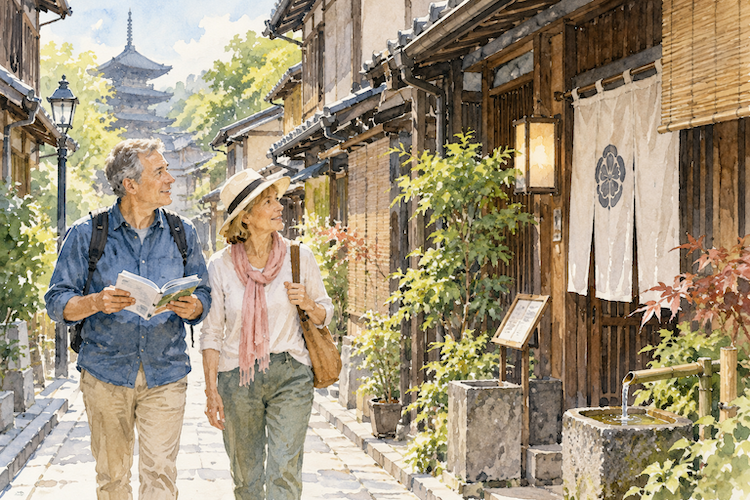
Exploring Japan — looking beyond the obvious to notice the details.
There is plenty to learn about Japan before you travel.
You can work out the trains, book your accommodation, learn a few useful Japanese words and make a list of the places you want to visit.
Yet some of the things that stay with you are often the things you never planned to see.
The quietness of a crowded train. The absence of public rubbish bins. Shoes neatly arranged at the entrance to a building. A tiny restaurant hidden down a side street. A vending machine beside a country road. The extraordinary efficiency of a railway station.
These are small observations, but together they begin to give you a feeling for the country.
Here are twenty things that may catch your attention on a first visit to Japan.
1. The quietness of a crowded train
One of the first impressions may be the relative quietness of Japanese public transport.
A train can be full of people and yet remain remarkably calm. Passengers read, look at their phones, talk quietly or simply sit.
Phone conversations on trains are generally avoided, and there is an awareness that the carriage is a shared space.
It is not silence. It is something subtler — a consideration for the people around you.
2. The order of everyday life
Japan has a remarkable ability to organise large numbers of people.
There are queues for trains, buses, restaurants and shops. Railway platforms often have clearly marked positions showing where passengers should wait.
When a train arrives, passengers generally allow those leaving the train to get off before boarding.
After a while, the system becomes almost invisible. You simply join in.
3. Clean streets and very few bins
One of the curious things about Japan is the combination of exceptionally clean public spaces and a relative shortage of public rubbish bins.
You may find yourself carrying an empty bottle or food wrapper for some time before finding somewhere appropriate to dispose of it.
It takes a little adjustment.
It also makes you more aware of the idea that keeping a public space clean is partly a shared responsibility.
4. The frequency with which shoes come off
Removing your shoes before entering a Japanese home is well known.
What may be less expected is how often the same principle appears elsewhere.
Traditional accommodation, some restaurants, temples and other buildings may have a designated place for shoes.
At a ryokan, removing your shoes becomes part of the transition from the outside world into the traditional interior.
Usually, the surroundings give you the answer. Look at what everyone else is doing.
5. The Japanese toilet
The Japanese toilet has become almost a cultural curiosity in its own right.
Heated seats, washing functions, adjustable water pressure and a collection of controls can make a simple visit surprisingly sophisticated.
Some controls are less obvious than others.
A sensible approach is to take a moment to look at the symbols before experimenting.
It is also worth knowing that some toilet control panels include an emergency alarm, so it pays to know which button you are pressing.
6. The remarkable convenience store
A Japanese convenience store, or konbini, is much more than a place to buy a drink.
Food, coffee, snacks, ATMs and various everyday services can all be found under one roof.
The food itself can be an enjoyable discovery.
A convenience-store breakfast may become part of a day's travel, particularly when setting off early for a train or heading somewhere without many restaurants.
The phrase "just popping into the convenience store" can acquire a very different meaning in Japan.
7. Vending machines become part of the landscape
Vending machines are everywhere.
At first they attract attention.
After several days, they become part of the scenery.
Then, perhaps, you notice one in a surprisingly remote location and remember just how ubiquitous they are.
Drinks are the obvious example, but the variety and distribution of vending machines is one of those small details that helps make Japan feel distinctly different.
8. Cash still has a place
Japan is one of the world's most technologically advanced countries, yet cash remains useful.
Electronic payments and cards are increasingly common, particularly in larger cities, but smaller businesses and some rural establishments may still prefer cash.
It is worth carrying some Japanese yen.
There is also the small matter of coins. Before long, your pockets can contain a surprisingly impressive collection.
A coin purse starts to seem like a very sensible piece of travel equipment.
9. Small restaurants can be memorable
Some of the best meals may come from somewhere that looks almost insignificant.
A handful of seats. A small kitchen. A short menu. Perhaps one speciality prepared exceptionally well.
Ramen, soba, yakitori, tempura or a simple set meal can all become memorable experiences.
There is something appealing about a restaurant that has concentrated on doing one thing well.
10. The care given to ordinary things
One of the most noticeable aspects of Japanese life is the attention given to presentation.
Food is arranged carefully. Purchases are wrapped beautifully. Shop displays change with the seasons. Packaging can be remarkably attractive.
A hotel room may contain a small detail that seems unnecessary until you realise it has been carefully considered.
The effect is rarely about extravagance.
It is more about care and attention.
11. Railway stations are places in their own right
A railway station in Japan may be far more than a place to catch a train.
Large stations contain restaurants, cafés, shops, food halls, convenience stores, underground shopping areas and connections to department stores.
Some are almost cities beneath a roof.
And then there is the challenge of finding your platform.
The Japanese railway system is wonderfully efficient, but a large station can still take some navigating.
12. Old and new live comfortably together
A centuries-old temple can sit within a modern city.
A traditional wooden building can stand beside a contemporary apartment block.
An ancient shrine can be only a short walk from a railway station or convenience store.
Japan often makes little distinction between its past and present.
The old does not necessarily have to be preserved in a separate historical quarter. It remains part of everyday life.
That juxtaposition can be one of the most fascinating aspects of travelling through the country.
13. The thoughtful use of small spaces
This may be particularly noticeable to anyone interested in design.
Space can be limited, especially in Japan's larger cities, yet small spaces are often carefully composed.
A narrow entrance. A compact restaurant. A tiny courtyard. A small garden. A shop occupying only a few square metres.
Rather than simply trying to make a small space appear larger, there is often a sense of making the available space feel complete.
It is an interesting lesson in design.
14. Efficiency and slowness exist together
Japan can be exceptionally efficient.
Trains run to precise schedules. Stations handle enormous numbers of people. Everyday transactions can be quick and organised.
Yet there are also many opportunities to slow down.
A cup of tea. A visit to a temple. A walk through an old neighbourhood. An evening in a ryokan. Time in an onsen. Sitting quietly in a garden.
Japan seems entirely comfortable with both speeds.
15. The seasons appear everywhere
In Britain, we are very aware of the seasons, but in Japan they often appear in a surprisingly wide range of everyday details.
Food changes. Menus change. Flowers and plants become part of displays. Packaging changes. Festivals follow the calendar. Seasonal sweets appear in shops.
The changing season becomes part of the visual and culinary experience of everyday life.
Once you start looking for it, seasonal references seem to be everywhere.
16. Consideration for other people
Many of the observations in this article come back to one underlying idea: consideration.
Keeping conversations quiet. Queueing. Avoiding obstruction. Looking after shared spaces. Being aware of the people around you.
Rather than thinking of Japanese etiquette as a long list of rules, it can be more useful to think about the principle behind many of them.
Other people are sharing this space with you.
That simple thought explains a surprising amount.
17. The extraordinary change when leaving Tokyo
Tokyo is enormous.
The buildings, crowds and railway system can be difficult to comprehend until you experience them first-hand.
Then you travel away from the city.
Suddenly there are mountains, forests, rice fields, small towns, traditional houses and quiet railway stations.
The change can be remarkable.
Japan is far more varied than the image created by its largest cities.
18. The experience of an onsen
An onsen can seem slightly mysterious before your first visit.
The procedure is actually quite straightforward.
You wash thoroughly before entering the bath. You leave your clothes in the changing area. A conventional public onsen is enjoyed without swimwear. Your small towel stays out of the water.
Then you simply soak.
There is no swimming and very little fuss.
An outdoor bath surrounded by mountains, woodland or a carefully designed garden can make the experience particularly memorable.
19. You begin to observe rather than simply look
At the beginning of a trip, much of your attention is practical.
Which train? Which platform? Where do I pay? Where do I leave my shoes? What does this sign say?
After several days, some of that uncertainty disappears.
You have more time to observe.
How someone enters a shop. How a meal is presented. How a purchase is wrapped. How people move through a station. How a ryokan is arranged. How a garden meets a building.
You begin asking a more interesting question:
Why is it like this?
That is often the point at which travelling becomes much more rewarding.
20. Japan may be different from the Japan you imagined
Perhaps the greatest surprise is how ordinary Japan can be.
There are temples, gardens, sushi, bullet trains, neon signs and spectacular landscapes.
But there is also everyday life.
People going to work. Children going to school. Someone buying breakfast at a convenience store. A commuter asleep on a train. A shopkeeper preparing for the day. An elderly couple visiting a local shrine. Someone sweeping outside their shop. A gardener tending a small patch of ground.
It is this ordinary Japan that may stay with you longest.
Look, rather than simply see
Perhaps the best advice for a first visit is very simple:
Look.
Look at how people use space.
Look at how things are presented.
Look at how buildings meet the street.
Look at how people move.
Look at the details.
Notice what changes between Tokyo and a small town.
And when something seems unfamiliar, rather than immediately asking whether it is right or wrong, ask:
Why is it like this?
You will not understand everything during one visit.
There is no need to.
Japan rewards curiosity, and some of the most interesting discoveries are often the ones that were never on the itinerary.
Further Information
For authoritative, up-to-date information about Japanese customs, etiquette, transport and responsible travel, the Japan National Tourism Organization provides a useful English-language resource:
Japan National Tourism Organization – Japanese Customs and Etiquette
For information specifically about experiencing an onsen:
Japan National Tourism Organization – How to Best Enjoy an Onsen
INFORMATION
CUSTOMER SERVICE
- Terms & Conditions
- Privacy statement
- Cookie Policy
- Payment Terms
- Delivery
- Mend a Paper or Shoji Screen
- Gravel calculator
- Zen Gardens and Why We Rake
- Japanese Stones and their Use
- Warlon Acrylic and Products
- Japanese Acrylic or Shoji Paper??
- Japangarden JPY to GBP Converter
- A Listening Journey Through Japanese Music
- Japangarden Weekly Focus
- Creating a Japanese Garden in a small space
MY ACCOUNT
CONTACT US
-
ADDRESS:
JapanGarden.co.uk
25 Pound Meadow, Ledbury
HR8 2EU, Herefordshire
United Kingdom (Great Britain) -
TELEPHONE:
+44 (0)1531 630091 -
EMAIL
Contact Us

Copyright © 2004-2026 JapanGarden.co.uk