

 Home
Home- Bamboo
- Granite
- Lighting
- Interiors
- Traditional Shoji Paper And Acrylics For Repair Or Manufacture
- Komika Range Of Handmade Tables And Benches
- Bespoke Shoji Screen Manufacturing Service
- Japangarden Interior Design Service
- Oriental Style Traditional Futons
- Tatami Flooring
- Interior BoxLights And Bamboo Lights
- Oriental Screens
- Traditional Hot Tubs And Japanese Style Oforu
- Oriental Style Furniture And Furnishings
- Calligraphy Brushes And Inks
- Exteriors
- Specimen Rocks
- Water
- Wind
- The Japangarden Guide
- Japangarden Design
Ma – The Japanese Concept of Space and Emptiness
Ma – The Japanese Concept of Space and Emptiness
In a Japanese garden, what is not there can be just as important as what is.
A gap between stones. An open area of gravel. A quiet space beneath a tree. The distance between two plants. A pause before a path turns.
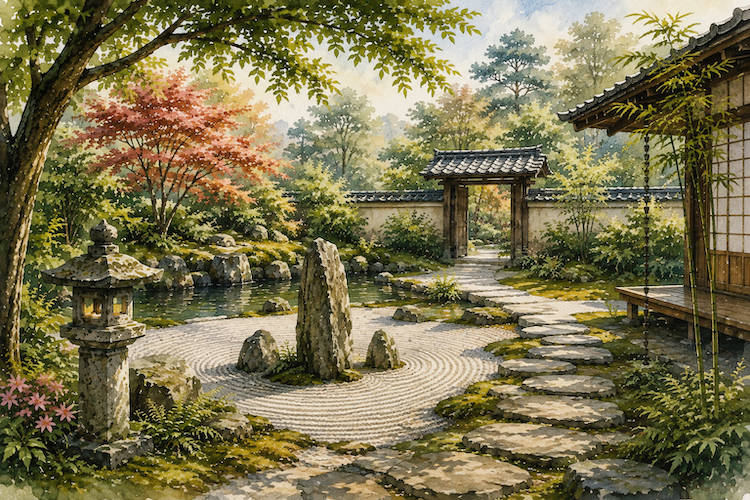
These spaces are not unfinished or waiting to be filled. They are part of the composition.
This idea is known in Japan as ma – a concept that describes the space, interval or pause between things.
Space is part of the design
In Western gardening, an empty area can sometimes feel like a problem. We may instinctively want to fill it with another plant, ornament or feature.
Japanese garden design takes a different approach.
Space gives the eye somewhere to rest. It allows individual elements to have greater importance and creates a sense of calm.
A single stone surrounded by gravel can have more presence than ten stones crowded together. A solitary tree can become a focal point because there is space around it.
Ma is not simply emptiness. It is the relationship between things.
The pause between elements
Think about a piece of music. The silence between two notes is not really silence. It helps give the notes meaning.
Ma works in a similar way.
The gap between two stepping stones affects the rhythm of walking. The open gravel surrounding a group of rocks makes the stones appear more substantial. A space between trees can frame a distant view.
Remove the space and the relationship changes.
This is one reason Japanese gardens can feel spacious even when they occupy a relatively small area.
Less, but with greater impact
The principle of ma encourages restraint.
Instead of asking, “What else can I put here?”, it can be more useful to ask:
“What can I leave out?”
A garden does not need every corner filled with planting. A carefully maintained area of gravel, moss or bare earth can provide an essential visual pause.
JapanGarden's Japanese garden gravel and aggregates include decorative stones suitable for paths, courtyards and areas around ponds, lanterns and stepping stones.
Ma and the Japanese dry garden
The idea becomes especially obvious in a karesansui, or dry landscape garden.
Raked gravel provides a broad field of open space, while carefully positioned stones create the principal forms. The gravel is not simply a background material. The empty areas around the stones are essential to the composition.
The spaces allow the stones to suggest mountains, islands or landscapes without attempting to reproduce them literally.
JapanGarden's feature stones for Zen gardens range from smaller stones to large boulders, allowing the designer to create different scales and relationships within the open space.
Stones need space
A Japanese garden stone should rarely feel as though it has simply been placed in an empty border.
Its position, orientation and the space around it all contribute to the composition.
A large specimen stone can become a powerful focal point when surrounded by gravel or low planting. Smaller stones can establish rhythm and balance without competing with the principal feature.
JapanGarden's specimen rocks, slate, pebbles and cobbles provide a wide range of natural materials for creating these relationships.
The important thing is not the number of stones but the space between them.
Space creates movement
Ma is not restricted to gardens viewed from a single position.
It can also influence the experience of walking through a garden.
A path may widen before narrowing again. A planting screen may conceal an open space until the visitor turns a corner. A small clearing may provide a moment to stop and look back.
The empty space becomes part of the journey.
Stepping stones can reinforce this rhythm. JapanGarden's granite tobi-ishi stepping stones are available in both round and square forms.
Their spacing and positioning are as important as the stones themselves.
Light, shadow and empty space
Ma also gives light and shadow somewhere to work.
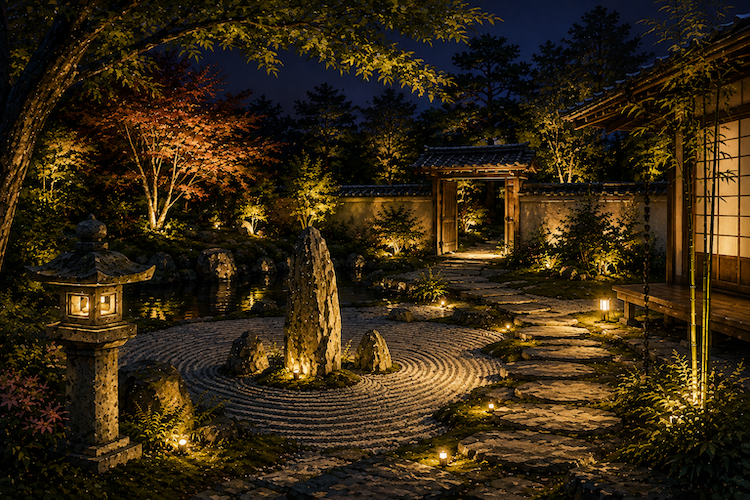
A tree casting shadows across gravel can create a constantly changing composition. Sunlight moving through branches may transform an apparently simple area throughout the day.
Nothing new has been added, yet the garden changes.
Water can have a similar effect. A quiet pool provides a reflective surface, while the space surrounding it allows reflections, movement and sound to become noticeable.
JapanGarden's stone lanterns and water basins offer traditional elements that can be positioned with generous space around them, allowing their form to become part of the wider composition.
For a more natural focal point, JapanGarden also supplies drilled glacial granite boulders for water features, where water, stone and surrounding space combine to create a quiet point of movement.
Ma in a British garden
You do not need a large Japanese garden to use the principle of ma.
In fact, it can be particularly valuable in a small garden.
Instead of filling every border, consider leaving a section of gravel or moss. Give a carefully chosen tree enough space around it to be appreciated. Use fewer ornaments, but position them more deliberately.
A simple arrangement might include:
- One significant stone with generous space around it
- A small group of carefully chosen plants rather than a crowded border
- An open gravel area
- A clear view towards one focal feature
- A path with deliberate pauses and changes of direction
- A quiet area beneath a tree
The objective is not minimalism for its own sake.
It is giving each element enough space to be noticed.
The beauty of the pause
Perhaps the easiest way to understand ma is to think about the moments when a Japanese garden seems particularly peaceful.
It may not be because there is an impressive feature in front of you.
It may be because there is nothing demanding your attention.
A gap between trees. An expanse of gravel. A stone sitting quietly in moss. The sound of water with nothing competing against it.
These pauses allow the garden to breathe.
And that is perhaps the most important lesson of ma for anyone creating a Japanese-style garden:
Do not feel that every space needs to be filled.
Sometimes the space itself is the most important part of the design.
INFORMATION
CUSTOMER SERVICE
- Terms & Conditions
- Privacy statement
- Cookie Policy
- Payment Terms
- Delivery
- Mend a Paper or Shoji Screen
- Gravel calculator
- Zen Gardens and Why We Rake
- Japanese Stones and their Use
- Warlon Acrylic and Products
- Japanese Acrylic or Shoji Paper??
- Japangarden JPY to GBP Converter
- A Listening Journey Through Japanese Music
- Japangarden Weekly Focus
- Creating a Japanese Garden in a small space
MY ACCOUNT
CONTACT US
-
ADDRESS:
JapanGarden.co.uk
25 Pound Meadow, Ledbury
HR8 2EU, Herefordshire
United Kingdom (Great Britain) -
TELEPHONE:
+44 (0)1531 630091 -
EMAIL
Contact Us

Copyright © 2004-2026 JapanGarden.co.uk