

 Home
Home- Bamboo
- Granite
- Lighting
- Interiors
- Traditional Shoji Paper And Acrylics For Repair Or Manufacture
- Komika Range Of Handmade Tables And Benches
- Bespoke Shoji Screen Manufacturing Service
- Japangarden Interior Design Service
- Oriental Style Traditional Futons
- Tatami Flooring
- Interior BoxLights And Bamboo Lights
- Oriental Screens
- Traditional Hot Tubs And Japanese Style Oforu
- Oriental Style Furniture And Furnishings
- Calligraphy Brushes And Inks
- Exteriors
- Specimen Rocks
- Water
- Wind
- The Japangarden Guide
- Japangarden Design
Creating Your Japanese Garden | A Practical Guide
Creating Your Japanese Garden | A Practical Guide | JapanGarden
Creating Your Japanese Garden
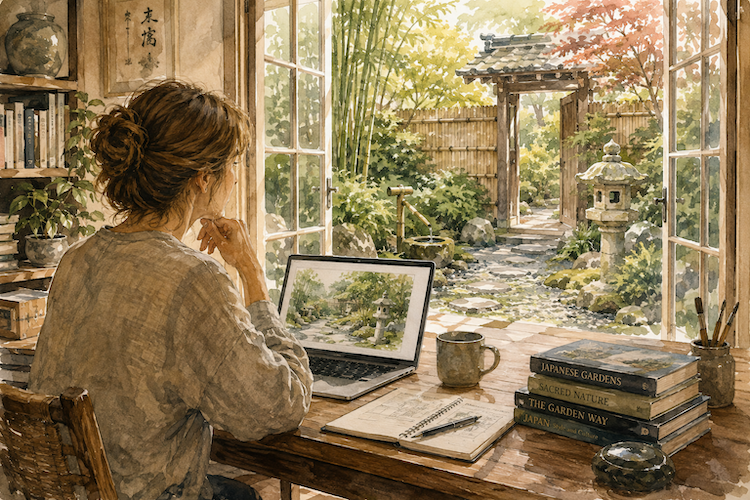
A practical guide to developing your own space
Perhaps you have an established garden and would like to give it a quieter, more considered character. Perhaps you are starting with an empty space, or simply wondering what might work in one particular corner.
There is no need to begin with a list of things to buy. The best place to start is by looking carefully at the garden you already have.
Before you choose anything, look at the space
Stand in the garden. Then look at it from the house, from the entrance and from the places where you normally sit.
Notice what draws your eye, what you would rather not see, where the garden feels exposed and where there is already something worth preserving.
- Where are the most attractive views?
- Which boundaries need softening or screening?
- Are there mature trees or plants that should remain?
- Where does the eye naturally come to rest?
- Would a change in the route through the garden make it more interesting?
- Is there a corner that could become a place to sit and pause?
These simple observations can tell you more about what the garden needs than a catalogue of products.
What would you like your garden to feel like?
Before deciding on individual features, think about the experience you want to create. There may be one particular problem you want to solve, or simply a quality you would like to introduce.
More private?
If neighbouring buildings or an unattractive boundary dominate the view, start there. Screening and planting can create a sense of enclosure and give the garden a calmer background.
More peaceful?
Sometimes the answer is subtraction rather than addition. Reducing clutter and giving important features more space can transform the character of an existing garden.
A place to pause?
Create somewhere from which the garden can be appreciated. A seat, a framed view, a stone or a carefully positioned tree can give the eye somewhere to settle.
A reason to explore?
Think about movement. A path, stepping stones, a gate or a partially hidden feature can make the journey through the garden part of the experience.
More sound and movement?
Water can introduce a gentle sense of movement and sound. A small basin or bamboo water feature may be enough; a pond is not essential.
A stronger entrance?
The point where you enter the garden can be particularly effective. A simple gate, bamboo screen, stone or change of surface can create a transition from one space to another.
Now consider what might help
Once you understand what you want to change, individual features become much easier to choose. Each should have a reason for being there.
Stone
For permanence, structure and a natural focal point. A single well-positioned stone can sometimes do more than several smaller features.
Explore Japanese feature stones →Lanterns
For height, emphasis and a point of interest. Consider the position first, then choose a form and size that belongs there.
Explore stone lanterns and basins →Water
For sound, reflection and movement. Even a relatively small feature can introduce a completely different quality.
Explore water features →Bamboo
For screening and enclosure, particularly where you need to soften a boundary or create a more intimate area.
Explore bamboo →Paths and stepping stones
For changing the way the garden is experienced. A route can encourage people to slow down, pause and discover the space.
Explore feature stones →Gravel
For creating calm open areas, defining paths or providing a simple ground surface around stone and planting.
Explore gravel and aggregates →Six ways you might approach your garden
1. A small urban garden
Imagine a narrow garden overlooked by neighbouring properties. There is no room for a large pond and the existing lawn is not particularly useful.
Rather than trying to recreate a complete landscape, concentrate on enclosure and a single focal point.
A bamboo screen could soften the boundary. A small gravel area could replace part of the lawn. A carefully positioned stone or lantern could provide a focal point, with restrained planting around it.
The result could be a quieter and more considered garden without requiring major structural work.
2. An established family garden
Suppose the garden already contains a lawn, mature tree and established borders, but feels rather disconnected.
There may be no reason to remove these things. Instead, concentrate on movement and connection.
A route of stepping stones could connect the house with a seating area. A small water feature could become a destination at the end of the route. Existing planting could be simplified and repeated rather than replaced completely.
The garden becomes more coherent while retaining much of what was already there.
3. A new garden from scratch
With an empty site there is more freedom, but that can actually make decisions harder.
Start with the main views and the route through the space. Decide where you want people to enter, pause and look.
Then introduce the major elements one at a time: structure, movement, water, planting and enclosure .
Leave space between them. The garden does not need to be filled immediately.
4. A garden viewed mainly from the house
If most of your garden is seen from a window or sitting room, design the composition around that viewpoint.
A carefully positioned stone, lantern or tree can become a visual focal point. Gravel and planting can frame it, while a partially concealed feature beyond can add depth.
You may not need a conventional path at all.
5. A garden where privacy matters
If neighbouring houses dominate the view, deal with that problem first rather than decorating the garden beneath it.
Bamboo fencing, screening and planting can create a stronger background. Once the boundary is quieter, a much smaller number of features may be needed in front of it.
6. Adding Japanese character gradually
Perhaps you do not want a major redesign at all.
Start with one area. Introduce a carefully chosen stone, a simple water feature or a section of bamboo screening. Observe the effect through the seasons before deciding what comes next.
A garden can evolve. It does not have to be completed in one go.
If you only change three things...
For many existing gardens, three carefully considered changes can make a greater difference than a large collection of Japanese features.
- Improve the background. Screen or simplify an unattractive boundary.
- Create a focal point. Choose one strong element and give it space.
- Change the journey. Introduce a path, stepping stones or another reason to move through the garden differently.
Then live with the changes for a while. You may find that you need much less than you originally thought.
When you are ready to choose the details
Once you have decided what your space needs, the JapanGarden ranges provide the individual elements with which to develop it.
Granite & Stone
Lanterns, basins, bridges, stepping stones, sculptures and other natural stone features.
Explore Granite & Stone →Water Features
Water basins, bamboo fountains, Shishi-Odoshi, pumps and other water-related features.
Explore Water →Bamboo
Bamboo fencing, screening, poles and other products for creating structure and enclosure.
Explore Bamboo →Gravel & Aggregates
Materials for paths, borders, courtyards and dry landscape gardens.
Explore Gravel & Aggregates →Would you like to explore further?
JapanGarden's Information section contains a growing collection of articles about Japanese gardens, their history, features, materials and traditions.
Explore JapanGarden Information →
If you have a particular question, try the JapanGarden Answers resource.
Have a garden in mind?
Sometimes it helps to talk an idea through. If you have a garden, a particular corner or simply a feeling you would like to create, tell us about it.
Continue exploring JapanGarden
INFORMATION
CUSTOMER SERVICE
- Terms & Conditions
- Privacy statement
- Cookie Policy
- Payment Terms
- Delivery
- Mend a Paper or Shoji Screen
- Gravel calculator
- Zen Gardens and Why We Rake
- Japanese Stones and their Use
- Warlon Acrylic and Products
- Japanese Acrylic or Shoji Paper??
- Japangarden JPY to GBP Converter
- A Listening Journey Through Japanese Music
- Japangarden Weekly Focus
- Creating a Japanese Garden in a small space
MY ACCOUNT
CONTACT US
-
ADDRESS:
JapanGarden.co.uk
25 Pound Meadow, Ledbury
HR8 2EU, Herefordshire
United Kingdom (Great Britain) -
TELEPHONE:
+44 (0)1531 630091 -
EMAIL
Contact Us

Copyright © 2004-2026 JapanGarden.co.uk