

 Home
- Bamboo
- Granite
- Lighting
- Interiors
- Traditional Shoji Paper And Acrylics For Repair Or Manufacture
- Komika Range Of Handmade Tables And Benches
- Bespoke Shoji Screen Manufacturing Service
- Japangarden Interior Design Service
- Oriental Style Traditional Futons
- Tatami Flooring
- Interior BoxLights And Bamboo Lights
- Oriental Screens
- Traditional Hot Tubs And Japanese Style Oforu
- Oriental Style Furniture And Furnishings
- Calligraphy Brushes And Inks
- Exteriors
- Specimen Rocks
- Water
- Wind
- The Japangarden Guide
- Japangarden Design
An Introduction to Kanji
An Introduction to Kanji
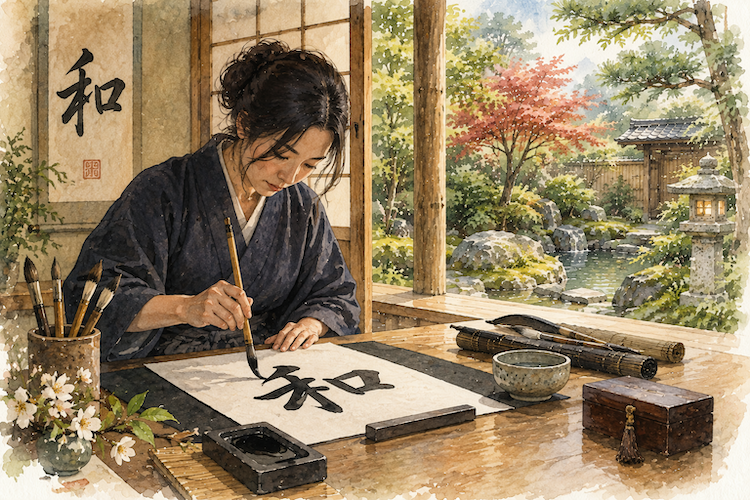
For anyone with an interest in Japan, few aspects of Japanese culture are more visually distinctive than Kanji — the Chinese characters incorporated into the Japanese writing system.
Seen on temple signs, garden inscriptions, ceramics, artworks, shop fronts and traditional scrolls, Kanji can appear almost like small works of art in their own right. But they are much more than decorative symbols. They form an important part of the written Japanese language and carry meanings, sounds and associations that have developed over many centuries.
What is Kanji?
The word Kanji (漢字) means “Chinese characters”, or more literally “Han characters”.
Japanese uses three principal types of characters:
-
Kanji (漢字) — characters primarily associated with meaning
-
Hiragana (ひらがな) — a phonetic script used extensively for grammatical endings and Japanese words
-
Katakana (カタカナ) — a phonetic script commonly used for foreign words, names and emphasis
Japan had no native writing system before the adoption of Chinese characters. Chinese writing was introduced gradually through cultural contact with the Asian mainland, including through the Korean peninsula, and was subsequently adapted for writing Japanese.
Over time, Japan developed its own ways of reading and using Chinese characters. Hiragana and katakana also developed from forms of Kanji.
The result is a writing system in which the three scripts work together. A single Japanese sentence may contain Kanji, Hiragana and Katakana side by side.
Are Kanji pictures?
This is one of the most interesting questions about Kanji.
Some Kanji preserve traces of very old pictographic forms. 木, for example, represents “tree” and has a long history associated with the representation of a tree.
However, it would be misleading to think of all Kanji simply as pictures.
Chinese characters developed through several different methods. Some were based on pictorial representations, while others indicated ideas, combined meanings, or used one element to contribute meaning and another to suggest pronunciation.
So while some Kanji have fascinating visual origins, Kanji as a whole are a much more sophisticated system than a collection of pictures.
A character can have more than one reading
One of the features that can make Kanji difficult for newcomers to Japanese is that a character may have several readings.
Take 木.
It can be read:
ki — the Japanese reading, meaning tree
boku — an on-yomi reading
moku — another on-yomi reading
These illustrate two broad categories of Kanji reading.
Kun-yomi
Kun-yomi (訓読み) is a Japanese reading associated with the meaning of the character.
For 木, ki is the familiar Japanese word for tree.
On-yomi
On-yomi (音読み) readings developed from Chinese pronunciations adopted into Japanese at different periods.
For 木, these include boku and moku.
Many Kanji therefore have more than one possible reading, depending upon the word in which they occur. Not every Kanji has both types of reading.
This is one reason learning Kanji is not simply a matter of memorising a symbol and one pronunciation.
Kanji in everyday Japanese
Kanji are frequently combined to create words.
For example:
木 — tree
山 — mountain
水 — water
石 — stone
庭 — garden
竹 — bamboo
A Japanese garden therefore provides a particularly enjoyable vocabulary for beginning to recognise Kanji.
日本庭園 (Nihon teien) means Japanese garden.
Here:
日本 (Nihon) — Japan
庭園 (teien) — garden
You will often encounter the same characters in different combinations, with their meanings contributing to the overall meaning of the word.
For a wider introduction to Japanese garden terminology, visit our Japanese Garden Vocabulary section.
日本 — Japan
The written name for Japan is:
日本
It is normally read Nihon or Nippon.
The individual characters are:
日 — associated with the sun or day
本 — associated with origin, base or source
These component meanings are interesting and have contributed to the familiar interpretation of 日本 in terms of the “origin of the sun”. However, it is better not to treat this simple gloss as a complete explanation of the historical development of the country's name.
For the beginner, the important point is simply to recognise 日本 as the written form of Japan.
東京 — Tokyo
Another familiar example is:
東京 (Tōkyō)
The characters are:
東 — east
京 — capital
Tokyo can therefore be understood through the component meanings of its two characters: “east” and “capital”.
Learning to recognise individual characters in this way can make Japanese place names and signs considerably more approachable.
Kanji and the Japanese garden
There is a natural connection between Kanji and the appreciation of a Japanese garden.
Japanese gardens frequently use concepts and vocabulary that are difficult to translate into a single English word. Learning even a small number of Japanese terms can therefore deepen an understanding of the garden itself.
Consider:
庭 — niwa
Garden
石 — ishi
Stone
水 — mizu
Water
木 — ki
Tree
山 — yama
Mountain
竹 — take
Bamboo
These are simple words, but they begin to reveal how the Japanese garden is described in its own language.
For more Japanese garden terminology, visit our Japanese Garden Vocabulary section.
Kanji as an art form
There is another dimension to Kanji which is particularly fascinating to Western eyes: calligraphy.
Japanese calligraphy, or Shodō (書道) — literally “the way of writing” — treats writing as an artistic discipline.
The movement of the brush, the pressure applied to the paper, the balance of the character and the quality of the ink all contribute to the finished work.
A beautifully written Kanji may therefore communicate on several levels at once: its literal meaning, its sound, its historical associations and the character of the brushwork.
This is one reason Kanji appears so naturally within traditional Japanese interiors and gardens.
JapanGarden has a selection of Japanese calligraphy brushes and inks, including Japanese inking brushes and traditional writing materials.
Paper, ink and the written character
Traditional Japanese writing has a close relationship with paper.
Washi, the broad Japanese term for traditional Japanese paper, encompasses a wide range of papers made using different fibres, techniques and qualities.
Japanese papers may be used for calligraphy, printing, conservation, crafts and traditional interiors.
The qualities of the paper — its absorbency, texture, strength and surface — affect the way ink behaves and therefore become part of the visual character of the finished work.
JapanGarden also supplies traditional Japanese Shoji paper, together with Japanese papers for print and calligraphy.
For those interested in the craft itself, our Handmade Japanese Papers section also explores traditional Japanese papermaking.
Kanji within a Japanese interior
A written character can become an important part of a Japanese interior without being treated simply as decoration.
A hanging scroll displayed within a tokonoma — the traditional recessed alcove found in many Japanese rooms — may contain calligraphy, painting or a combination of the two.
The restraint of the setting is important. A single character or carefully chosen scroll can provide a visual and philosophical focus without overwhelming the space.
JapanGarden's Tokomono Scroll Type is one example of a traditional-style hanging scroll, featuring a hand-painted horse.
Learning Kanji without becoming a linguist
You do not need to learn thousands of characters to begin appreciating Kanji.
Start with a small number of words connected to things that already interest you.
For the Japanese garden, this might mean learning:
庭 — niwa — garden
石 — ishi — stone
水 — mizu — water
木 — ki — tree
竹 — take — bamboo
山 — yama — mountain
Then begin looking at how these characters appear in combinations and in the names of places, gardens and cultural objects.
Over time, the visual symbols that initially seem mysterious begin to become familiar.
More than writing
Kanji occupy an unusual position between language, history and visual art.
They arrived in Japan as part of a much wider exchange of ideas and writing from the Asian mainland, but were subsequently adapted and developed within Japanese culture. Their meanings, readings and written forms have continued to evolve, while their visual presence remains an unmistakable part of Japanese life.
For anyone interested in Japanese gardens, learning a little Kanji can add another layer of appreciation.
A stone can become 石.
A tree can become 木.
A garden can become 庭.
And gradually, the written language begins to reveal another way of seeing the Japanese landscape.
INFORMATION
CUSTOMER SERVICE
- Terms & Conditions
- Privacy statement
- Cookie Policy
- Payment Terms
- Delivery
- Mend a Paper or Shoji Screen
- Gravel calculator
- Zen Gardens and Why We Rake
- Japanese Stones and their Use
- Warlon Acrylic and Products
- Japanese Acrylic or Shoji Paper??
- Japangarden JPY to GBP Converter
- A Listening Journey Through Japanese Music
- Japangarden Weekly Focus
- Creating a Japanese Garden in a small space
MY ACCOUNT
CONTACT US
-
ADDRESS:
JapanGarden.co.uk
25 Pound Meadow, Ledbury
HR8 2EU, Herefordshire
United Kingdom (Great Britain) -
TELEPHONE:
+44 (0)1531 630091 -
EMAIL
Contact Us

Copyright © 2004-2026 JapanGarden.co.uk