

 Home
Home- Bamboo
- Granite
- Lighting
- Interiors
- Traditional Shoji Paper And Acrylics For Repair Or Manufacture
- Komika Range Of Handmade Tables And Benches
- Bespoke Shoji Screen Manufacturing Service
- Japangarden Interior Design Service
- Oriental Style Traditional Futons
- Tatami Flooring
- Interior BoxLights And Bamboo Lights
- Oriental Screens
- Traditional Hot Tubs And Japanese Style Oforu
- Oriental Style Furniture And Furnishings
- Calligraphy Brushes And Inks
- Exteriors
- Specimen Rocks
- Water
- Wind
- The Japangarden Guide
- Japangarden Design

Practical Tips for a Japanese Style Shade Garden

Design a Japanese Shade Garden
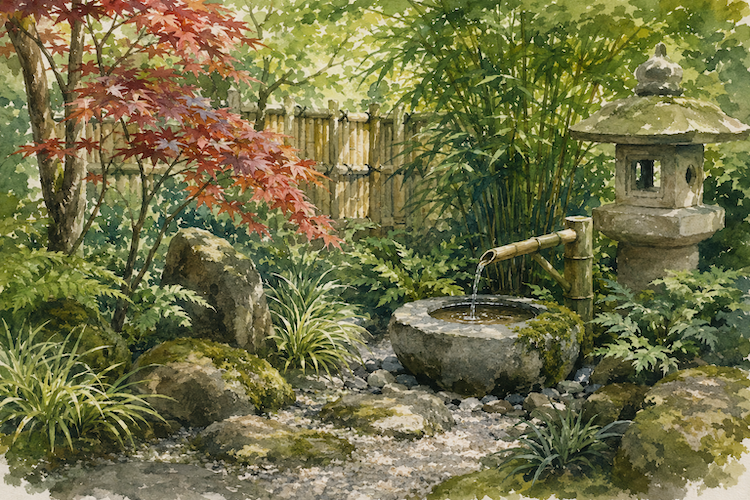
Creating calm, beauty and atmosphere in the shaded garden
Shade is not a problem to overcome. In a Japanese garden, it can become one of its greatest assets.
Filtered light beneath trees, moss, stone and deep green foliage create a garden that feels cool, quiet and timeless. Rather than filling a shady area with colour, a Japanese approach uses texture, form, light and shadow.
The best gardens respond to their own conditions, using plants and materials that thrive in the British climate.
Start with the shade
Before choosing plants or features, observe the area.
Is it:
- Lightly shaded beneath deciduous trees?
- Deeply shaded by buildings or evergreen trees?
- Damp and naturally mossy?
- Dry beneath established trees?
- Sheltered from wind?
These differences matter. A garden beneath a mature tree may be dry, while a north-facing corner can remain cool and damp.
Work with the site, not against it.
The beauty of filtered light
Sunlight filtering through leaves creates movement across stone, timber and foliage. Shadows become part of the composition.
This is particularly effective with:
- dark green foliage
- pale granite
- weathered timber
- moss
- bamboo
- water
- simple gravel surfaces
In Japanese garden design, what is not seen can be just as important as what is seen.
Choose plants for form and texture
Japanese-style planting is not about collecting exotic plants. Plants are selected for shape, foliage, texture, seasonal interest and the way they mature.
Japanese Maple — Acer palmatum
A classic choice for dappled shade. Its delicate foliage and branching structure catch changing light beautifully, while autumn colour provides seasonal transformation.
Hakonechloa — Japanese Forest Grass
Hakonechloa macra is particularly valuable in shady gardens. Its flowing leaves soften the edges of paths, stones and paving.
Ferns and moss
Ferns provide excellent texture, while moss can become one of the garden's most beautiful features where conditions are cool and damp.
Rather than treating moss as a weed, allow it to develop around stones, beneath trees and along shaded edges.
Ophiopogon, Liriope, Azaleas and Camellias
These can provide evergreen structure and seasonal interest, but should be used selectively.
The aim is not a display of flowers, but a quiet seasonal moment.
Japangarden's approach to UK planting is based on form, restraint, seasonality and space rather than simply choosing plants because they are Japanese.
Japangarden – Practical Tips for UK Plants in a Japanese Setting
Let stone become the structure
A shady garden benefits enormously from carefully placed stone.
Stone provides permanence when planting is dormant and creates a beautiful contrast with soft foliage and moss.
Think of stones as part of the garden's underlying structure rather than decoration.
A simple group of three stones can be more effective than many smaller rocks scattered around the garden.
One dominant stone
One supporting stone
One lower stone
Partially burying them helps them appear to emerge naturally from the ground.
Japangarden's advice on standing stones emphasises fewer stones, asymmetrical positioning and allowing open space around them.
Japangarden – Zen Standing Stone Construction
Use gravel and open space
Shade does not mean every available area needs to be planted.
Ma — meaningful empty space — is an important part of Japanese garden design.
A fine silver-grey gravel area can provide a quiet foreground against darker planting, while a small paved area creates somewhere to pause and look into the garden.
Japangarden's standing-stone guidance specifically recommends fine silver-grey gravel, compact slate and moss for shaded, damp areas, while discouraging busy paving and mixed decorative aggregates.
The principle is simple:
A garden becomes calmer when there is somewhere for the eye to rest.
Water works particularly well in shade
Water and shade are natural companions.
A simple stone water basin, or tsukubai, introduces sound, reflection and movement without requiring a large pond. In shade, water reflects surrounding foliage and picks up subtle changes in light.
Japangarden – Traditional Granite Water Basins
A traditional bamboo Kakei water spout adds another layer of movement and sound. Japangarden's Kakei is available in different heights and can be used with a stone water basin or as a simple water feature.
Traditional Japanese Style Bamboo Kakei Water Spout
For a wider choice:
Japangarden – Granite Water Basins
Bamboo as a screen and backdrop
Bamboo can be particularly effective where a shady garden needs privacy or a darker background.
A bamboo screen can:
- disguise an unattractive boundary
- provide a calm background
- create enclosure
- frame a view
- reinforce the Japanese character of the garden
Japangarden offers bamboo, reed and brushwood screening in a variety of styles and sizes.
Japangarden – Bamboo, Reed & Brushwood Screening
For a more substantial project, Japangarden also offers bamboo fencing, screening, poles and traditional tying materials.
Japangarden – Bamboo Fences, Screening & Poles
Lanterns and subtle lighting
A shade garden can be particularly beautiful in the evening.
Rather than brightly illuminating the whole garden, pick out individual elements: a maple, moss-covered stone, water basin, path or lantern.
A traditional granite lantern can become an effective focal point when partially surrounded by planting.
Japangarden – Traditional Oriental Granite Lanterns
The current range includes several traditional forms, including Yukimi lanterns that are particularly appropriate for a smaller, intimate garden.
A simple planting palette
For a typical British shade garden, a restrained palette might include:
Upper layer
Acer palmatum · Betula · carefully trained evergreen forms
Middle layer
Azaleas · Camellias · Ilex crenata · Ferns
Ground layer
Hakonechloa · Ophiopogon · Liriope · Moss
Structural elements
Granite · gravel · bamboo · weathered timber · water
You do not need all of these.
In fact, the garden will usually be stronger if you choose fewer.
Less variety. More intention.
A simple Japanese shade garden
For a small garden, consider a composition built around just a few elements:
1. One Japanese maple
Place it slightly off-centre.
2. Three character stones
Use different sizes and shapes, partially buried into the ground.
3. A small area of moss
Allow it to develop naturally in the dampest part.
4. Hakonechloa
Use repeated clumps rather than lots of different plants.
5. A gravel area
Create breathing space between planting and the viewpoint.
6. One focal feature
A lantern, water basin or carefully positioned stone is sufficient.
The result should feel composed but not crowded.
Create a garden that improves with age
One of the great advantages of a Japanese-style shade garden is that it becomes more beautiful as it matures.
Moss develops. Stone weathers. Timber changes colour. Trees develop character. Plants become established and gradually merge into one composition.
This is different from a conventional garden designed to look finished immediately.
A Japanese garden should have patina, restraint and a sense of time.
The objective is not to create a perfect picture on the day it is planted, but to create the conditions for a garden that becomes increasingly natural and tranquil.
Inspired by Japan, designed for Britain
At Japangarden, we believe a Japanese-style garden should respond to its location.
The most convincing gardens are not replicas of gardens in Kyoto. They take the principles of Japanese design — simplicity, asymmetry, natural materials, seasonal change, borrowed scenery and the thoughtful use of space — and interpret them for the British landscape.
Shade provides an opportunity to create something particularly atmospheric.
Use the darkness. Celebrate the foliage. Let the moss grow. Give the stones space. Allow the garden to breathe.
The result can be one of the most peaceful areas of your garden.
Explore Japangarden
For more ideas, inspiration and practical advice:
Japangarden Design & Practical Tips
Japanese-Style Planting for UK Gardens
Zen Standing Stone Construction
Traditional Oriental Granite Lanterns
Bamboo, Reed & Brushwood Screening
INFORMATION
CUSTOMER SERVICE
MY ACCOUNT
CONTACT US
-
ADDRESS:
JapanGarden.co.uk
25 Pound Meadow, Ledbury
HR8 2EU, Herefordshire
United Kingdom (Great Britain) -
TELEPHONE:
+44 (0)1531 630091 -
EMAIL
Contact Us

Copyright © 2004-2026 JapanGarden.co.uk