

 Home
- Bamboo
- Granite
- Lighting
- Interiors
- Traditional Shoji Paper And Acrylics For Repair Or Manufacture
- Komika Range Of Handmade Tables And Benches
- Bespoke Shoji Screen Manufacturing Service
- Japangarden Interior Design Service
- Oriental Style Traditional Futons
- Tatami Flooring
- Interior BoxLights And Bamboo Lights
- Oriental Screens
- Traditional Hot Tubs And Japanese Style Oforu
- Oriental Style Furniture And Furnishings
- The Copper Bathing And Washing Collection
- Calligraphy Brushes And Inks
- Exteriors
- Specimen Rocks
- Water
- Wind
- The Japangarden Guide
- Japangarden Design

The Japanese Garden Entrance – Creating the Transition
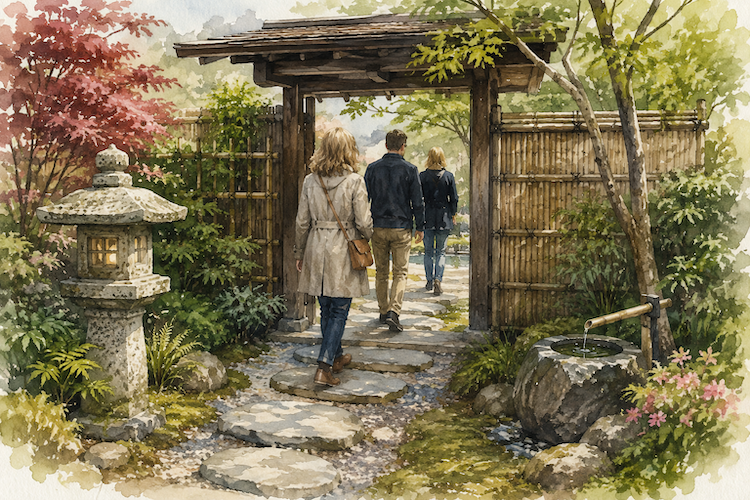
The Japanese Garden Entrance – Creating the Transition
A Japanese garden entrance is more than a way into the garden. It is a transition from one world to another – a moment when the pace of everyday life begins to slow and the garden gradually reveals itself.
Rather than showing everything at once, a Japanese garden often creates a sense of anticipation. A gate, screen, change of direction or carefully positioned plant may conceal the garden beyond, encouraging you to pause and look.
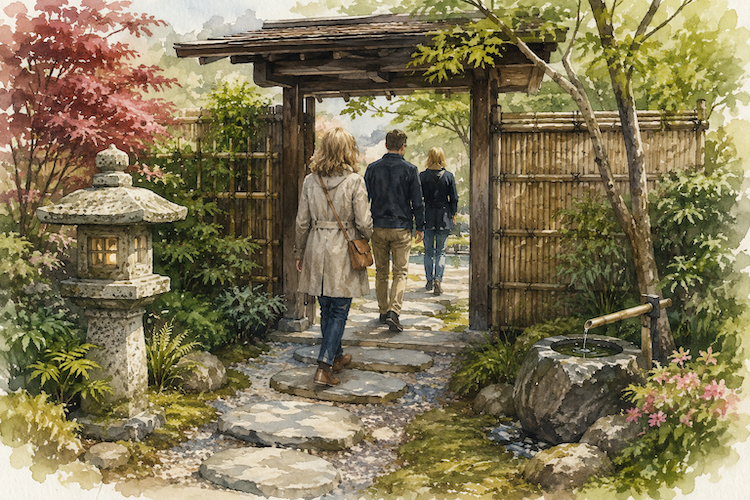
The entrance as a threshold
The Japanese garden traditionally creates a distinction between the ordinary world outside and the quieter landscape within. This does not necessarily require a grand entrance. Even a small garden can create this feeling through the careful arrangement of a path, planting and boundary.
The important principle is separation and discovery.
A direct view straight into the garden can be replaced by a partially obscured view. A path can turn slightly rather than leading directly to its destination. A screen or planting can hide part of what lies beyond.
The result is a garden that is gradually discovered rather than immediately revealed.
Creating anticipation
One of the most effective techniques is to give visitors only a glimpse of what is ahead.
A Japanese-style entrance might use a simple gate or timber structure, followed by a short path that changes direction. Bamboo, shrubs or a carefully positioned stone can interrupt the view, while an opening beyond provides a tantalising glimpse of the garden.
This idea of concealment and revelation is particularly important in Japanese garden design. The visitor becomes part of the composition, discovering different views as they move through the space.
The path into the garden
The path should encourage a measured pace.
Stepping stones (tobi-ishi) can be used to guide movement and give the entrance a natural rhythm. They do not need to form a perfectly straight line. Slight changes in direction and spacing encourage the visitor to look down, then up again, noticing the garden around them.
JapanGarden offers a selection of traditional granite stepping stones, including round and square tobi-ishi.
The stones should feel as though they belong to the landscape rather than appearing as a formal pavement. Their position, spacing and relationship to planting are often more important than their individual appearance.
Gates, screens and framing
A gate can establish the character of the garden before the visitor has even entered it.
A traditional Torii has a particular cultural and symbolic role, and JapanGarden already has detailed information about the different forms and construction of Torii.
For a domestic garden, however, the same principle can be achieved with a simpler timber gate, bamboo screen or partially enclosed entrance.
The purpose is not necessarily to create a barrier. It is to frame the entrance and control the first view.
A lantern at the entrance
A lantern can provide a strong focal point without overwhelming the entrance.
Traditionally, stone lanterns were associated with illumination and were used to guide people through gardens, particularly around paths and approaches. JapanGarden's range includes several traditional forms.
The Kasuga lantern, for example, is a substantial pedestal lantern that can be particularly effective near a gate, entrance or path intersection.
A lantern should be positioned as part of the overall composition rather than simply placed beside the path. Its relationship with trees, stones and the entrance itself is what gives it presence.
Planting the entrance
Planting should help create the feeling of transition.
Evergreen shrubs can provide structure, while Japanese maples and other deciduous trees introduce seasonal change. Bamboo, grasses, moss and carefully clipped shrubs can soften hard boundaries and partially obscure the view beyond.
The entrance does not need to be densely planted. A little concealment can be more effective than a wall of greenery.
Allowing a branch to extend into the view, or positioning a shrub so that only part of a lantern or building can be seen, can create depth and encourage curiosity.
Texture and movement
The transition can also be created through changes in surface.
A paved approach might gradually become gravel or stone. A formal boundary can give way to planting. The sound of footsteps on stone can replace the harder surface of a conventional path.
Small details matter.
A weathered stone, moss-covered edge or naturally irregular stepping stone can help the entrance feel established and connected to the garden beyond.
JapanGarden also supplies larger natural and glacial stones that can be used to create focal points, boundaries and transitions within a garden.
Creating a Japanese-style entrance in a UK garden
You do not need a large garden or an elaborate Japanese gate to create this effect.
A simple approach might consist of:
- A modest timber or bamboo entrance
- A short path of natural stepping stones
- Planting that partially conceals the garden
- One carefully positioned stone or lantern
- A change in direction before the main garden is revealed
- A glimpse of water, planting or a focal feature beyond
The important thing is not to reveal everything immediately.
Even in a small British garden, a simple entrance can create the feeling that you are leaving one space behind and entering another.
The journey begins before the garden
The entrance is therefore part of the garden itself.
Japanese garden design often asks us to slow down, observe and discover rather than simply move from one place to another. The entrance establishes this feeling from the very beginning.
A gate frames the view. A screen creates mystery. Stepping stones regulate the pace. Planting softens the boundary. A lantern provides a quiet point of focus.
Together, these elements create something more important than an entrance.
They create the moment of transition.
INFORMATION
CUSTOMER SERVICE
- Terms & Conditions
- Privacy statement
- Cookie Policy
- Payment Terms
- Delivery
- Mend a Paper or Shoji Screen
- Gravel calculator
- Zen Gardens and Why We Rake
- Japanese Stones and their Use
- Warlon Acrylic and Products
- Japanese Acrylic or Shoji Paper??
- Japangarden JPY to GBP Converter
- A Listening Journey Through Japanese Music
- Japangarden Weekly Focus
- Creating a Japanese Garden in a small space
MY ACCOUNT
CONTACT US
-
ADDRESS:
JapanGarden.co.uk
25 Pound Meadow, Ledbury
HR8 2EU, Herefordshire
United Kingdom (Great Britain) -
TELEPHONE:
+44 (0)1531 630091 -
EMAIL
Contact Us

Copyright © 2004-2026 JapanGarden.co.uk