

 Home
- Bamboo
- Granite
- Lighting
- Interiors
- Traditional Shoji Paper And Acrylics For Repair Or Manufacture
- Komika Range Of Handmade Tables And Benches
- Bespoke Shoji Screen Manufacturing Service
- Japangarden Interior Design Service
- Oriental Style Traditional Futons
- Tatami Flooring
- Interior BoxLights And Bamboo Lights
- Oriental Screens
- Traditional Hot Tubs And Japanese Style Oforu
- Oriental Style Furniture And Furnishings
- Calligraphy Brushes And Inks
- Exteriors
- Specimen Rocks
- Water
- Wind
- The Japangarden Guide
- Japangarden Design
Japanese Philosophy — Ancient Ideas in Modern Japan
Japanese Philosophy — Ancient Ideas in Modern Japan
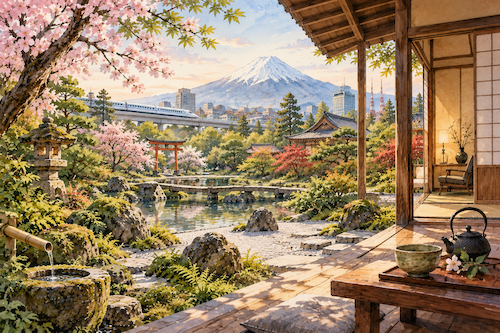
Japan can sometimes feel like two countries at once. There are bullet trains travelling at extraordinary speeds, robots, convenience stores open around the clock and some of the world's most advanced technology. Yet alongside all this modernity are shrines hidden among ancient trees, temples surrounded by moss, carefully prepared meals, seasonal festivals and gardens designed to encourage quiet contemplation.
These things are not simply relics of an older Japan. Many of the ideas behind them continue to influence Japanese culture today. They come from several different traditions — particularly Shinto, Buddhism and Confucian thought — together with centuries of Japanese interpretation and adaptation.
Understanding a little of this background can change the way we look at Japan.
For a wider introduction to the cultural ideas and traditions associated with Japan, see Japanese Culture, Philosophy & Traditions.
Shinto — nature as something to be respected
Shinto is Japan's indigenous religious tradition. Rather than being centred on a single founder or sacred text, it developed around the idea of kami — sacred presences associated with natural phenomena, particular places, ancestors and other aspects of existence.
This helps explain something that visitors often notice in Japan: the extraordinary respect given to particular natural features. A waterfall may have a shrine beside it, an ancient tree may be regarded as sacred, and a mountain may be both a geographical feature and a spiritual place. A large stone may even be marked with a rope to indicate its significance.
Shinto does not mean that every Japanese person regards nature in explicitly religious terms. Modern Japanese life is far more complex than that. But the tradition has contributed to a cultural sensitivity towards particular places, natural features and the changing seasons.
It is one reason that a Japanese garden can feel less like a collection of plants and more like a carefully composed relationship with nature. JapanGarden's guide to the various styles of Japanese gardens explores some of the ways that nature, symbolism and landscape have been brought together in garden design.
Buddhism — impermanence and the passing of time
Buddhism arrived in Japan from the Asian mainland during the sixth century and subsequently developed into a number of distinctly Japanese traditions.
One of its enduring ideas is impermanence — the recognition that everything changes. Nothing remains exactly as it is. Flowers bloom and fall, leaves emerge and disappear, buildings weather and people grow older.
This awareness of impermanence became deeply embedded in Japanese culture. The Japanese expression mono no aware describes a sensitivity to the passing nature of things and the emotions that can accompany it.
Cherry blossom provides perhaps the most familiar example. Its beauty is partly connected with its brevity. The flowers are at their most beautiful precisely because they do not remain.
The same thought can be found in a Japanese garden. Moss slowly covers a stone, a maple changes colour, a bamboo fence begins to weather and a raked gravel surface is disturbed by wind and rain. The garden is never quite the same twice.
Zen and the value of attention
Zen Buddhism became particularly influential in Japanese arts and culture, although its influence should not be exaggerated into an explanation for everything Japanese. Zen emphasises disciplined practice, direct experience and attentive awareness, and its influence can be seen historically in areas including the tea ceremony, calligraphy, garden design and various forms of traditional art.
A Zen garden is therefore not simply a garden that happens to look minimalist. The absence of unnecessary decoration can encourage attention. A single stone becomes noticeable, an empty area of gravel becomes part of the composition and a carefully framed view becomes something to contemplate rather than simply pass.
This is one reason Japanese gardens can reward slow observation. They do not necessarily reveal everything at once.
JapanGarden's article Zen Gardens and Why We Rake looks more closely at dry gardens, raked gravel and the visual language associated with these spaces.
The same qualities can be found in the work of the great haiku poet Matsuo Bashō. His poetry often found profound meaning in apparently simple observations of nature, travel and everyday life. JapanGarden's Bashō article explores how his ideas of simplicity, restraint, impermanence and walking can be understood alongside Japanese garden design.
Confucian thought — respect, learning and responsibility
Confucian ideas arrived in Japan from China and became particularly influential in education, government and social organisation. Confucian thought places importance on relationships, learning, responsibility and appropriate behaviour within society.
Some of the respect for teachers, elders and established social roles found historically in Japan can be understood partly through this tradition, although Japanese society has always been influenced by many different factors. Its influence is also visible in the importance historically placed on education and self-cultivation.
The idea that a person develops through learning and disciplined practice has a long history in Japan. That same attitude can be seen in traditional crafts, where becoming skilled is often understood as something that takes years of repetition rather than something achieved quickly.
Why does this still matter in modern Japan?
It would be misleading to suggest that modern Japanese people consciously live according to ancient philosophy. Most people are not thinking about Shinto, Zen or Confucianism while commuting to work.
The influence is often much quieter than that. It survives in customs, aesthetics, expectations and ways of doing things.
A family may visit a shrine at New Year without considering themselves particularly religious. Someone may enjoy cherry blossom without thinking about Buddhist philosophy. A craftsman may concentrate intensely on perfecting a traditional technique without describing the activity in philosophical terms. A visitor may admire an old tree simply because it is beautiful.
Tradition does not always survive as a set of beliefs. Sometimes it survives as a way of doing things.
This is part of what makes Japanese culture so interesting to explore alongside the physical garden. JapanGarden's Japanese Culture, Philosophy & Traditions section brings together a number of these subjects.
The importance of the seasons
Few aspects of Japanese culture demonstrate this better than the changing seasons. Spring brings cherry blossom, summer brings festivals and lush green growth, autumn brings spectacular colour and winter reveals the structure of trees, stone and architecture.
Seasonal foods, decorations, festivals and celebrations remain an important part of Japanese life. The seasons also provide a reminder that change is normal.
A Japanese garden makes this particularly visible. The same garden can look completely different in April and November. It is not necessarily designed to reach one perfect finished appearance; its character develops through time.
This sensitivity to seasonality is particularly clear in the Japanese Tea Ceremony. The tea ceremony changes with the seasons, with flowers, utensils, food, atmosphere and even the preparation of tea reflecting the time of year.
The tea garden itself also forms an important part of the experience. The approach through stone, moss, water and carefully controlled views creates a gradual transition away from the outside world. Like a Japanese garden, it encourages us to slow down enough to notice what is around us.
Wabi-sabi — finding beauty in change
The term wabi-sabi has become extremely popular outside Japan, sometimes to the point where its meaning has been simplified almost beyond recognition.
It is better understood as a complex aesthetic sensibility associated with simplicity, imperfection, age and impermanence.
A weathered wooden gate can have more character because it has weathered. A stone does not need to be perfectly symmetrical. A handmade bowl may be valued partly because it carries the marks of its maker.
In a Japanese garden, age can become part of beauty. Moss growing over stone is not necessarily something to remove, while weathered timber may be preferable to something that looks newly manufactured. The passage of time becomes part of the design.
JapanGarden's Japanese Garden Vocabulary includes a useful introduction to wabi-sabi, as well as related Japanese garden terms such as ma, karesansui, niwaki and tsukubai.
Ma — the importance of space
Another useful Japanese concept is ma. There is no single English word that translates it perfectly. It can refer to space, interval, pause or the relationship between things.
In Japanese design, what is absent can be as important as what is present. A garden does not need to be filled with plants, a room does not need to be filled with furniture and a pause in music can be as important as the notes around it.
This idea is particularly relevant to Japanese gardens. A carefully placed stone may be surrounded by an apparently empty area, but that empty space is not necessarily empty at all. It creates room for the eye to rest.
JapanGarden has a dedicated article exploring this idea in greater depth: Ma — The Japanese Concept of Space and Emptiness.
The tea ceremony provides another particularly clear example. The tea room is deliberately modest and free from unnecessary distraction. Natural materials, carefully chosen objects and empty space work together. What has been left out is as important as what has been included.
From philosophy to everyday life
Perhaps the most interesting thing about Japanese philosophy is not that ancient ideas survive unchanged. They do not. Japan has changed enormously.
What is interesting is the way older ideas have sometimes been absorbed into everyday culture and transformed along the way.
Respect for nature can exist alongside highly developed cities. Traditional craftsmanship can exist alongside advanced robotics. Ancient shrines stand beside modern railway stations. A centuries-old garden can be visited by people carrying smartphones.
The old and the new do not necessarily have to compete. In Japan, they often exist side by side.
What can a Japanese garden teach us?
Perhaps this is where these ideas become most interesting for us.
A Japanese garden gives physical form to some very old ways of thinking. It reminds us that nature changes, that things age, that space matters, that attention matters and that beauty does not always require perfection.
It also suggests that a garden can become more interesting rather than less interesting as time passes.
The work of Bashō offers a particularly useful parallel. His approach was to notice rather than over-explain — to find significance in a moment, a path, a tree, a sound or a change in the landscape. Japanese gardens often work in much the same way. They do not necessarily tell us what to think; they create the conditions in which we can notice.
These are not uniquely Japanese ideas, and they do not belong exclusively to Buddhism or Shinto. But Japan has developed a particularly rich visual language for expressing them.
That may be one reason Japanese gardens continue to fascinate people far beyond Japan. They offer not simply somewhere beautiful to look at, but a different way of looking.
For those interested in applying some of these principles to their own garden, JapanGarden's Japanese Gardening — an understanding provides a practical introduction to restraint, space, planting and the use of stone.
Explore more
Ikigai — The Japanese Art of Finding Meaning in Everyday Life
Bashō — Poetry, Nature and the Japanese Garden
Understanding the Tea Ceremony
Ma — The Japanese Concept of Space and Emptiness
Japanese Garden Vocabulary — including Wabi-sabi
The Various Styles of Japanese Gardens
Japangarden explores Japanese gardens, Japanese culture and the ideas behind them — helping us to understand not only how Japanese gardens are created, but why they can have such a powerful effect upon us.
INFORMATION
CUSTOMER SERVICE
- Terms & Conditions
- Privacy statement
- Cookie Policy
- Payment Terms
- Delivery
- Mend a Paper or Shoji Screen
- Gravel calculator
- Zen Gardens and Why We Rake
- Japanese Stones and their Use
- Warlon Acrylic and Products
- Japanese Acrylic or Shoji Paper??
- Japangarden JPY to GBP Converter
- A Listening Journey Through Japanese Music
- Japangarden Weekly Focus
- Creating a Japanese Garden in a small space
MY ACCOUNT
CONTACT US
-
ADDRESS:
JapanGarden.co.uk
25 Pound Meadow, Ledbury
HR8 2EU, Herefordshire
United Kingdom (Great Britain) -
TELEPHONE:
+44 (0)1531 630091 -
EMAIL
Contact Us

Copyright © 2004-2026 JapanGarden.co.uk